December 31, 2007
Cosmicomics
Continuing the cosmological adventures I began earlier this week, I am re-reading Italo Calvino's beautiful and magnificent set of stories about the building blocks of the universe. With adventures such as aquatic trips to the moon (to collect its cheese, no less), the romance of evolving sea-creatures, and interstellar games of marbles, these stories use particles in love and galaxies in formation as the characters.
The narrator, Qwfwq, frames each of the stories; in some he appears as a character, in others he relates an episode from a relative's life: "Pitch-dark it was, —old Qfwfq confirmed,— I was only a child, I can barely remember it. We were there, as usual, with Father and Mother, Granny Bb'b, some uncles and aunts who were visiting, Mr. Hnw, the one who later became a horse, and us little ones." So begins "At Daybreak", a story about the condensation of matter and about how stars form.
The first story, "The Distance of the Moon", is among the most beautiful I have read: its charming premise has both hopeless romanticism and sheer adventure, and the name of Mrs Vhd Vhd the Captain's wife makes me laugh.
Timothy, or, Notes of an Abject Reptile
Timothy the tortoise can live longer than a Selborn resident, longer than a bishop. He figures from an 18th-century narrative by the naturalist Gilbert White. Drawing from White's natural history, Verlyn Klinkenborg presents Timothy's perspective on the human and animal comings and goings in Selborn. The gentle staccato of Timothy's narration weaves a comfortable, bucolic cloth for a story with neither beginning nor end.
Verlyn Klinkenborg is one of America's most insightful and thoughtful writers, and his Timothy, or, Notes of an Abject Reptile makes for superb reading.
White's The Natural History of Selborne is one of the most-printed works in English (although Klinkenborg notes that it has just fallen out of print for the first time in centuries); it contains White's detailed notes on his household and environs, and forms the primary source for Timothy's observations and musings in Notes. White also developed the ha-ha, a sunken fence used in landscaping and zookeeping. The Bronx Zoo features a sweeping view across its replica savannah, but a ha-ha keeps the lions confined to their area while the gazelle and impala gallop past. (White would not aspirate the first syllable, pronouncing it "a-ha" rather than "ha-ha"); the San Francisco Zoo used other fences, less effectively.
Éphémère
This tart, fruity beer comes from the wizards at Unibroue. I first had it from a small bottle a few months ago, at the delicious Point Brugge café in Pittsburgh; through a friend's forgetfulness (about to board an airplane, could not take these delicious beers with him, many regrets, will you please do the honors) I came into possession of this large bottle as well as several others.
Served cool, the slightly cloudy beer has a great deal of carbonation; this bubbliness suits the fruit flavours of berries and apple, but sets off the beer itself in an odd way. The head is thick and creamy, and the carbonation plays no small part in this. The sourness of the fruit and the bright spices (cinnamon and nutmeg) do not quite match the mild taste of the beer, and although a glass-ful of this is delicious I am not sure I enjoyed the whole 750mL bottle.
tun
tun |tən| a large beer or wine cask; a brewer's fermenting vat. Also an imperial measure of capacity, equal to 4 hogsheads. To store beer or wine in a tun.
Probably of Gaulish origin; from the Old English tunne, ex. medieval Latin tunna.
December 30, 2007
Aviopolis
Aviopolis combines cultural theory, schematic illustrations, technical photographs, and discourse in a beautiful book -- and I just picked it up for the pictures! The book forms part of a multi-media project published by two students at the University of New South Wales, exploring the concepts of metastability and noplace: the ever-changing physical presence of these cities, which could be anywhere. The Narrator's monologue from "Fight Club" came to mind: "You wake up at Seatac, SFO, LAX. You wake up at O'Hare, Dallas-Fort Worth, BWI. Pacific, mountain, central. Lose an hour, gain an hour. This is your life, and it's ending one minute at a time. You wake up at Air Harbor International. If you wake up at a different time, in a different place, could you wake up as a different person?"
Reading through Aviopolis, I was struck by its provocative notion that the airport is the city of the future, and that this city could be any place: never mind the strip malls, the homogenized main streets from Frankfurt to Lisbon to Tokyo: the airport, our portal from each city to the next, is everyplace but noplace.
December 29, 2007
Death by Black Hole
This book covers a topic not readily found in popular-science books: cosmology. With its attendant complications of physics, chemistry, and philosophy, cosmology is a difficult topic to ravel into a book. In this collection, Neil deGrasse Tyson addresses fundamental questions of the development and organization of the universe with just the right amount of detail: the enthusiasm he shows for his topic while discussing how stars form, or the very early timeline of the universe, makes this book very enjoyable. It kept me awake at night, wondering about where the initial energy for the Big Bang originated.
The book suffers from two problems: the author's unfortunate sense of humor, which leads to many flip remarks; and from poor editing. Drawing from the author's years as a magazine columnist, the book collects articles without providing coherence. Thus, the reader hears anew every few pages about who Copernicus was, or Kapteyn, or why carbon so easily and abundantly bonds to other atoms; the book also has a handful of embarrassing typographical errors ("it's" for "its", et c.), but I now find this unsurprising about any book, article, or weblog rant recently published. The flippancy detracts from the otherwise-admirable flow of each article; I was especially impressed with the discussion of Lagrange points, where the author's ability to elegantly explain a complex mathematical and physical concept shined.
Cosmology is a rich but challenging topic, for the reader but especially for the author. Unlike Steven Weinberg's lucid but technical "The First Three Minutes", "Death By Black Hole" is gripping, enchanting in much the way that the cosmos itself is: replete with mystery and bursts of illumination. I did not understand enough of Stephen Hawking's writing, and too many other writers on the topic bring a lack of expertise or any elegance to their erudition.
Tyson, a cosmologist at the Natural Museum of History in New York City, also published a pleasant photoessay on stars in New York City online.
December 28, 2007
In which we offer money for our own subjugation
This online-only piece in the New York Times's JetLagged column surprised me with its frankness and length:
The airlines, for their part, are in something of a bind. The willingness of our carriers to allow flying to become an increasingly unpleasant experience suggests a business sense of masochistic capitulation. On the other hand, imagine the outrage among security zealots should airlines be caught lobbying for what is perceived to be a dangerous abrogation of security and responsibility — even if it’s not. Carriers caught plenty of flack, almost all of it unfair, in the aftermath of September 11th. Understandably, they no longer want that liability.As for Americans themselves, I suppose that it’s less than realistic to expect street protests or airport sit-ins from citizen fliers, and maybe we shouldn’t expect too much from a press and media that have had no trouble letting countless other injustices slip to the wayside. And rather than rethink our policies, the best we’ve come up with is a way to skirt them — for a fee, naturally — via schemes like Registered Traveler. Americans can now pay to have their personal information put on file just to avoid the hassle of airport security. As cynical as George Orwell ever was, I doubt he imagined the idea of citizens offering up money for their own subjugation."
Despite glaring systemic and amusingly obvious holes in the security of airlines, the agenda continues to be both reactive and unnecessarily disruptive. As cynical as George Orwell ever was, I doubt he imagined the idea of citizens offering up money for their own subjugation.
The prevailing notions of physical security around air travel stick in my craw not only because I spend an inordinate amount of time and energy flying from place to place, but also because the notions are wrong. Wrong-headed, and with the worst sort of ignorant, wrong intentions: these are measures that reflect no sophistication on the part of policy-makers or of law-enforcement, reinforcing the glorious stereotypes the legislative and executive branches have as dunder-headed troglodytes. We have massive models for the prediction of weather and traffic; and we have the ability to place a massive yellow first-down line underneath the image of football players onscreen; but we cannot reliably secure our transportation, merely provide the irritating illusion that we are doing something.
Sir Gawain and the Green Knight
This riveting new translation, presented in a side-by-side text with the original on the left-hand side and the modern English on the right, brought new joy to this stirring tale.
The translator's preface brought to my attention many of the poetic conventions, devices, and methods that the author, known as The Pearl Poet, brings to this epic: alliteration, especially, is a delightful and strong element of the poetry. In reading this translation, I found myself reading aloud: The New York Times review by Edward Hirsch brought to my attention many of the basic elements of this poem that escaped me twenty years ago, when I first read Sir Gawain and the Green Knight (for a high-school English class, perhaps?).
In reading Simon Armitage's excellent new translation of Sir Gawain and the Green Knight, I enjoyed the work in a way that I have not enjoyed an epic in English since Robert Fagles's translation of The Odyssey.
A full text, with notes by J R R Tolkien and E V Gordon, appears at the University of Michigan's web site.
December 27, 2007
In which unique is where you find it.
In a volume of Isaac Asimov's collected stories, "The Edge of Tomorrow", one of the most enjoyable stories is "Unique is Where You Find It", about a neurotic graduate student and his obstinate advisor, and their discussion of the naming of elements. I came across a reference to an element called "ekamanganese"; this aroused my curiosity, as the parts of the name looked familiar, yet I was certain that no element exists with this same name. A look across the Internet produced a citation to a note that presents reasons why Mendeleev chose now-superseded Sanskrit names for eight elements in the periodic table. The Russian scholar Dmitri Mendeleev created the periodic table of the elements, a masterpiece of instructional design and a wonder in its many aspects, and also predicted the composition of many elements not yet discovered in his day.
The syllable eka comes from the Sanskrit word meaning "one"; it appears as an element in many Sanskrit words. No pun intended. Time Magazine noted in 1930 that "Eka, Sanskrit for one or first, is a prefix applied to the first undiscovered element in a group of the periodic system."
The connections between classical Sanskrit poetry and Mendeleev's periodic table strike me as sublime. The author of the note above reaches the conclusion that "... Mendeleev, by using Sanskrit names, was tipping his hat to the Sanskrit grammarians of yore, who had created astonishingly sophisticated theories of language based on their discovery of the two-dimensional patterns in basic sounds." One of the more interesting passages in the note come from "private communication" between the author and the linguist (ha, there's another fine Sanskrit word for you) Paul Kiparsky: who found "striking similarities between the Periodic Table and the introductory Śiva Sūtras in [5th-century grammarian] Panini’s grammar ...".
The Asimov story uses the faithful mechanism of "The butler did it" (sort of) to wrap up its narrative, but the exposition contains a succinct discussion, courtesy of Asimov's Black Widowers Club, of almost all the elements and the composition of their names.
December 25, 2007
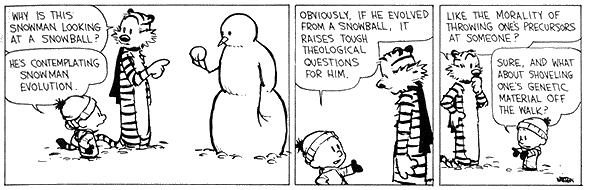
In which it is snow joke
 >
>
Lots of Calvin and Hobbes snow cartoons, hurray! Now, if it weren't for Al Gore's global warming shenanigans, we could get some snow and make our own snowman!
December 24, 2007
How Right You Are, Jeeves
Tangled love-affairs, mistaken identities, cases of insanity, and overbearing aunts: were it not for the appearance of the coveted cow-creamer, this might be a Shakespearean comedy. This comic novel follows the tried-and-true Wodehouse formula of placing the cheerfully inept Bertie Wooster in a country-house setting, tasked by his genial agèd relative with some ridiculous social task, but bereft of his helpmeet Jeeves. Various engagements fall as Bertie ploughs through the estate, a new pair of white linen trousers meet ruin, and no mice are found in the visiting scion's bedroom, but all ends well as Jeeves, freshly-fed from his shrimping holiday, swoops in to save the day. How Right You Are, Jeeves is another diverting piece of Wodehouse.
December 23, 2007
In which I cheat, and enjoy it
Rex Parker, who Does the NYT Crossword Puzzle, is not only a welcome helpmeet, but his commentary both illuminates and amuses. He adds clip art, relevant movie posters, and welcome exegesis for the daily puzzle. I first found him when, stuck in a particularly nasty puzzle (must have been Thursday, the utter limit of my ability), I needed to cheat; now I enjoy reading his analysis after all the cheating is done and accounted-for.
I don't now how the one-nine-hundred toll line ("$1.49 a minute") survives.
In which we move from spider to lamb

Maché, or lamb's lettuce, is my new favourite green. It succeeds spider mustard on the throne. Rinsed, dried, and chilled, it makes a spectacular salad for almost any meal.
December 21, 2007
Old Howling Bastard &c.
I was the only one (of seven!) not carded a few evenings ago as I sat and enjoyed a few pints from Blue Point Brewing: the delicious, mellow Oatmeal Stout from the cask, preceded by the Old Howling Bastard, a barleywine that had too much of a hoppy crispness for my taste.
I also recall an evening not too long ago in which I had a glassful of Old Viscosity, and was happy to discover that Port Brewing have a seasonal, Older Viscosity. Lovely!
December 20, 2007
In which we stop to admire a Taxicab
Once, in the taxi from London [to Putney], Hardy noticed its number, 1729. He must have thought about it a little because he entered the room where Ramanujan lay in bed and, with scarcely a hello, blurted out his disappointment with it. It was, he declared, "rather a dull number," adding that he hoped that wasn't a bad omen."No, Hardy," said Ramanujan. "It is a very interesting number. It is the smallest number expressible as the sum of two [positive] cubes in two different ways."
The Taxicab problem is well-documented, including two entries in the On-Line Encyclopedia of Integer Sequences: A011541 and A047696.
To many mathematicians, the mere mention of the number 1729 recalls the incident involving mathematicians G.H. Hardy and Srinivasa Ramanujan; thus, to commemorate the Hardy-Ramunujan conversation, the least number which is the sum of two positive cubes in n different ways is called the nth taxicab number: For any n >= 1, there indeed exist numbers which are the sum of two positive cubes in n ways, which guarantees the existence of Taxicab(n) for n >= 1. A corollary: Cabtaxi(n) the smallest positive integer which can be written as the sum of two positive or negative cubes in n ways.
December 19, 2007
In which there are a lot of artholes
The new installation at Gavin Brown Gallery: a whacking big hole in the ground. Not as impressive as Doris Salcedo five-hundred-foot crevasse at the Tate, but I suppose space in the West Village is more dear than in Bankside (no! can't be!).


In which we cycle past
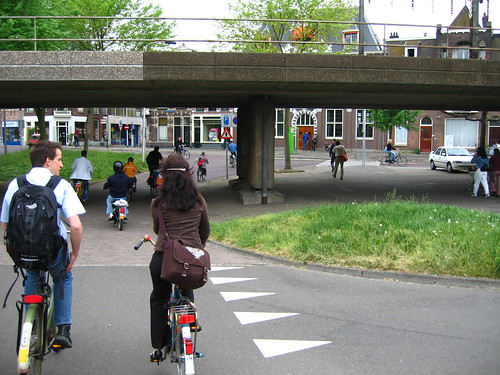
The Science Times article about Donald Norman and usable design mentions Delft, a Dutch town of which I am especially fond. Norman discusses the goals of usability, and how predictable behaviour manifests in many aspects of everyday life:
To get along with machines, Dr. Norman suggests we build them using a lesson from Delft, a town in the Netherlands where cyclists whiz through crowds of pedestrians in the town square. If the pedestrians try to avoid an oncoming cyclist, they're liable to surprise him and collide, but the cyclist can steer around them just fine if they ignore him and keep walking along at the same pace. "Behaving predictably, that's the key," Dr. Norman said. "If our smart devices were understandable and predictable, we wouldn't dislike them so much." Instead of trying to anticipate our actions, or debating the best plan, machines should let us know clearly what they're doing.
The ordinary should be ordinary.
December 18, 2007
Distributed Systems: Principles and Paradigms
Reading an author as energetic as Andrew Tanenbaum explain concepts of distributed processing, network topology, and resource allocation is all sorts of awesome. This second edition of the work, by Vrije Universiteit Amsterdam colleagues Tanenbaum and Marten van Steen brings together the essential concepts of distributed computing. I kept forgetting that it is a text, written for use in the classroom, until I reached the end of each chapter and found the exercise questions ( some answers available online) -- it is as thrilling to read as any mystery book.
In which everything is less than zero
Another piece of artistic rebellion ("You had better do as you are told / you had better listen to your radio!"):
Wikipedia sez: Costello wanted to play "Radio Radio" on SNL. Columbia Records, Costello's US label, on the other hand, was interested in having an already-established song performed on SNL, to stoke the fires of interest in the band prior to the American release of My Aim Is True and This Year's Model. In the event, Costello began the SNL performance by playing "Less than Zero." However, after a few bars, he turned to the Attractions, waving his hand and yelling "Stop! Stop!," then said to the audience, "I'm sorry, ladies and gentlemen, there's no reason to do this song here," possibly referring to the obscure story behind "Less than Zero," which was written as a reply to British fascist Oswald Mosley. He then led the band in a performance of "Radio Radio." Costello was banned from Saturday Night Live for twelve years. This version of "Radio Radio" (fading into the "false start") can be found (in monaural) on Saturday Night Live: 25 Years of Musical Performances, Vol. 1.
This happened thirty years ago, and I knew naught. The first Elvis record I picked up was the four-track EP (12"!) of "Less Than Zero" on Stiff Records, probably from the musty and dusty basement record shop adjacent the musty and dusty Carribean restaurant (who puts a restaurant in a basement?) on the once-glorious main drag of "upstreet" in Squirrel Hill.
Suffolk and E Houston

Gothamist on the mystery bench; more photographs of the mysterious high-bench, from Lev2k7.
December 16, 2007
Allagash White
Winter suggests delicious, spicy beers and fluffy piles of snow. I'm doing well on the beer portion: I had a huge bottle of the Allagash White, an especially delicious, mildly-spiced, wintry beer. This is by far my favourite of the spicy seasonal beers I have tasted in the past few weeks (the Blue Moon; Blue Point Brewing's Toasted Lager (of which I have since enjoyed several more bottles!); the Vuuve and Southampton, both of which were very distinctive and delicious; and St Peter's Winter Ale, which was downright disappointing.
Snow! Where are you?
December 15, 2007
In which he has to go when the whistle blows
I had not been following the shenanigans around Dr David Kessler and UCSF, and the news of his dismissal took me aback (the official press release is marketing crap).
Dr Kessler's energetic work at the FDA led to the very thorough implementation of new food-labelling act, which first made me aware of what it was that I was hustling down my gullet.
Carter Beats The Devil
From the setting in post-'quake, post-Depression San Francisco (thrilling!) to the themes (of romance and adventure, although stopping short of swashbuckling), and especially because of the thrilling series of escapes, I found Carter Beats The Devil one of the most engaging novels I have read. Treading the same landscape of Americana as the Michael Chabon's Adventures of Kavalier and Klay, but with fewer of the deep issues of cultural identity, Glen David Gold has produced an outstanding first novel. The quality of his historical and topical research shines through each page, but he makes the characters -- including the protagonist, drawn directly from current events -- entirely his own. This book is fully on the novel side of historical novel, and the plot, secondary characters and agonistes all come from Gold's pen. His sentences roll together merrily, and his dialogue evokes not only the era but the past-times and trades of the characters.
December 13, 2007
In which I cannot spell worth a dam'
accommodate vs. recommend
curiosity
however: instal, traveller,
and: hiccough, kerb,
what would I do with the OS's built-in red-underlining (nuts to the green)?
December 12, 2007
In which the art is what you make [of] it
&tThe current installation at the Tate Modern fascinates me, although I have not seen it. Reading about the reactions that visitors have to seeing Doris Salcedo's massive five-hundred-foot-fissure in the imposing Turbine Hall reminds me that art is in the eye (and sometimes dexterity) of the beholder.
Word of [another] mishap prompted a discussion among visitors of whether it might be wise to erect barriers around the exhibit, or seal it with some kind of Plexiglass-type material.
No, was the consensus.
“I think that would completely ruin the excitement of it,” said Rachel Laine, whose 2-year-old son, Charlie, was peering into the crack, searching for crocodiles. “The whole concept of why people are coming here is to see a huge concrete floor with a crack in it.”
I take this quotation, and the preceding narrative, from Sarah Lyall's excellent article in yesterday's New York Times, which I am only reading today.
Art is subjective, as is pornography, as is marketing (or is that art?). Eye of the beholder, caveat emptor, look before you leap.
In which the tough gets weird
One obstacle that Josef K. did not face was the thrill of waiting hours, time and again, to enter the court of justice.
[ ... A ] construction flagger for the Metropolitan Transportation Authority, said his custody and child support case against his wife had been dismissed three times because each time he was delayed in line and missed a hearing. Each time he had to petition again to restart the case.Now he carries the court clerk’s number with him, so he can phone in when he is downstairs. Even with the steady rain beating down on his coat, he said this morning wasn’t that bad.
He was standing only 20 yards from the entrance of the building. Even with the long line inside, he would probably be upstairs in about an hour, certainly less than two. The thought cheered him.
“Sometimes I arrive here and I am standing outside Law and Government High School,” he said, referring to the Bronx School for Law, Government and Justice several hundred yards away.
December 11, 2007
apophenia
apophenia is an invented word, coined in 1958 by Klaus Conrad and describes the ;spontaneous perception of connections and meaningfulness of unrelated phenomena", such as seeing the sainted Virgin Mary in a burrito wrap or Elmer Fudd in the oil shimmering on the macadam after a light rain. More examples of apophenia, including some terrifying observations from Strindberg, reveal this condition (syndrome?) as some sort of spontaneous creativity.

Somewhat related, I began reading Gavin Pretor-Pinney's The Cloudspotter’s Guide, an unexpectedly amusing and enthusiastically comprehensive guide to clouds.
In which the prevalent attitude creeps up again
An Asian-looking fellow gets hauled off to the station while photographing a subway station. He is suing the NYPD:
Police sources said officers question people photographing the city’s rail infrastructure on “rare occasions,” citing instances in which law enforcement officials have identified men taking photographs of city bridges and subways as Iranian intelligence agents and suspected Pakistani terrorists who were stopped by police while taking pictures of the Brooklyn and Williamsburg bridges.
“I was surprised and upset that I could be handcuffed on the street for taking a photograph,” Wiita said. “What was really disheartening was that I knew this has probably happened before and that it could happen again to anyone.”
This sounds all too familiar. I just got a new camera, in fact: time to try it out! (Bye the bye, I have lots of photographs of subways and bridges already.)
December 10, 2007
Blue Moon and their Winter Ale
As the standard-issue Blue Moon has plenty of citrus flavour and a spicy nose, I wondered what their seasonal Winter Ale would taste like. It has a much heavier sweetness, but also a tart finish that is not altogether pleasant. I made my way through about three-quarters of the pint before returning to the regular ale, which is a pleasant accompaniment to bar food and a football game. As for the beer's uncertain provenance: I should have been tipped off by the cut-rate models parading around with coupons for Coors Light and entries for a raffle to win a Coors Light football. Back at the home-front I am enjoying a tallboy of another fine Lagunitas limited-release, the Cappucino Stout.
Thus: I have been drinking Coors along with the odd plate of wings and spicy fries at the local bar.
December 9, 2007
December 8, 2007
Karlheinz Stockhausen
Karlheinz Stockhausen died. This memorial booklet (PDF) represents some of the significant influences of Stockhausen's work: the spiritual, language, and the sound of sound.
December 7, 2007
In which we vault the turnstile
Some reflections on reading a NYT article on plans to enforce fares in the Los Angeles Metro transit system.
I have long thought that San Francisco should adopt this model: make fares voluntary. None of this nonsense about the honor system (which works in a place like Genève, with a homogeneous population and, importantly, uniform cultural ideas); make fares voluntary. I suppose that [insert economic theory here ] people who can pay, will pay; people who would ordinarily expend energy hopping turnstiles will be able to put their efforts towards something more productive, like cheating people out of pension funds or clear-cutting old growth forests.
The numbers make sense:
As a result, the report said, the authority lost about $5.5 million in revenue annually.Fare-collecting gates, which could cost $30 million to install and $1 million a year to maintain, would yield an extra $6.77 million in recovered fares and other savings, according to the report.
In San Francisco, the cost of fare collection makes up somewhere between one-quarter and one-third of MUNI's operating budget. That is significant, but does not in itself justify eliminating fare-collection systems. When one adds in the difference that not requiring fares might make to a bus's headway, however, the time savings become a strong argument for eliminating fares. -- especially as MUNI still cannot meet the 85% voter-mandated on-time record.
One of the endearing images of fare evasion: the opening passages of Naked Lunch: "I can feel the heat closing in, feel them out there making their moves, setting up their devil doll stool pigeons, crooning over my spoon and dropper I throw away at Washington Square Station, vault a turnstile and two flights down the iron stairs, catch an uptown A train ...". Big up to Wm. S.
Class Trip / The Mustache
Two novels by Emmanuel Carrère: "Class Trip" and "The Mustache". The former has an uneven balance between development, climax, and denouement; despite its marvellous premise, the quantities of prose devoted first to the exposition and then to the development threw me off, and I felt disengaged from the first half of the novel while reading the second.
The latter of the two novels, The Mustache, however, bowled me over. Wow. This novel combines a phenomenal exploration of a marriage with a existential drama, all wrapped in a powerful narrative with small and muscular plot developments. This is certainly one of the few novels that has so gripped me, and amongst the most haunting. Lighter than Kafka, but sharing the aspects of an increasingly confused narrator, The Mustache focuses very strongly on the character at its core.
Starting with the innocuous decision of shaving his moustache, the protagonist falls into an increasingly opaque confusion. He struggles first with his wife and his friends, who swear that he never had a moustache, and slowly descends into a state of ambivalence about whether he had the moustache or not, whether he is who he thinks he is, and whether he can return to his pre-barbered condition.
This second novel, The Mustache, is fantastic. It is one of the most thrilling stories I have read, as full of intrigue and plot as a Dashiell Hammett novel; as thoughtful and langourous as a Haruki Murakami story. The author adapted it for the screen a few years ago; the novel itself he wrote in 1985.
Although the book does not explore it fully, it touches on a theme I consider essential to the modern urban gentleman: facial hair is a fantastic ornament. Moustache contests! Beard competitions! A man's cheeks and chin are a palimpsest, n'est pas? The book also has a particularly stirring and amusing passage set around Place de la Republique, dear to my heart.
In which he has to be crazy, a little bit.
The Palo Alto Daily brings Martin "cycle-across-America" Krieg to our attention, again, but omits the interesting piece of the vehicle code . The first (and only!) time I rode a high-wheeler was by the good grace of a fellow from the East Bay, whom I met at Crissy Field last spring (or autumn; I'm not good with seasons).

December 6, 2007
Wachusett Country Ale
The Wachusett Country Ale has a pleasant good-afternoon sweetness to it. If I can find it on tap somewhere nearby, I will go to that pub and drink it. It has the promise and taste of exactly the sort of beer that I would settle on stoop with and get down to business.
From the New York Times, recent articles and blog bits about taking good beer seriously. I do so enjoy the good taste of beer
Not until I began drinking beer from Magnolia Pub did I realise: this is beer. Fresh, made with love, and sold in growlers. Magnolia was also conveniently close to the stoop, which led to much merriment and joy.
Total Fucking Godhead

This weblog trucks in repeats, but "total fucking godhead" really is the necessary phrase. This is the mid-nineties, and I am still enraptured by its music. Luna's sublime "Bewitched" (with its guitar melodies like liquid valium -- who wrote that?); The Magick Heads' very very pretty "Before We Go Under" with none of the twee attendant Belle and Sebastian et al.; the Tindersticks heartbreaking 1995 album, with its lush orchestration and sonorous vocals. Gastr del Sol's "Mirror Repair" EP — which for me holds the images of Jean Cocteau's movie rather than the quotidian computer-monitor problems which actually inspired the title, and the records is mine to deconstruct — ; and Tortoise.
The mid-Nineties brought stunning indie-pop albums, too, with Pavement's concept album about their California and The Magnetic Fields' concept albums about the road and travel. I suspect those had a lot to do with my itch to move to the West Coast, or at least to get moving, although Tindersticks' "Travelling Light" (and the flip-side, "I've Been Loving You Too Long") figured in there heavily. June of '44 and Rex rocked the math, Rachel's did something that transformed how hipsters listened to instruments, and bringing together the frenzy of the rhythm section, the inventiveness of instruments, and a captivating stage presence, Tortoise.
Although Elvis Costello's GIRLS +£÷ GIRLS =$& GIRLS covers music from another decade entirely, I include it for completeness. It presaged math rock. And Tortoise.
December 5, 2007
In which we propose a quieter world
If all the world were compiled, rather than interpreted, things would run much more smoothly. Imagine: all the portions of the day that are dead routine, such as brushing one's teeth, trimming the mustaches, walking to the office.
Individuals could choose to optimize breakfast, if they always stop at the corner for a coffee ("regular"1) and danish (or, in a C++0x world, I suppose that would be at the Coffee King for a decaf non-fat triple Americano &mash; "We make it different, here" — and a muffin). They could optimize sleep (wow! this is fantastic) and ... now I am thinking about debuggers and inspecting elements, and this whole idea is becoming less amusing.
1On reflection, perhaps "regular" would be a localization thing.
Mandela Parkway and Peralta
The Chronicle printed a picture by Paul Chinn that makes an especially desolate part of Oakland look unusually beautiful:

Aram and I found a handsome dog all alone in this median a few years ago, while the green area was yet under development. It appeared well-fed and was quite well-behaved, but it wouldn't leave us alone. We were heading to Chicago that same morning and could not take it with us.
December 4, 2007
In which everything's gone green
The Landprint project [ English version here ] renders photographs on meadows, greenswards, lawns, and pastures by using robotic mowers. The projects uses specially-cultivated grass, having studied the growth patterns and appearance of various plantings, as well as the modified lawnmower.
Crop circles have nothing on this -- ?
Another foreign-language website with a succinct artistic idea: Face Your Pockets (in Russian and in English). Scan your face and the contents of your pockets. Some of the scans are striking beautiful in the juxtaposition of material goods and fleshy faces. For several months I kept a (paper) inventory of my pockets, in the days that I wore a field jacket and pocket-y pants. Now all one finds in my pocket are a wooden-handled folding knife, billfold, key, and telephone; everything else is in my briefcase.
December 3, 2007
A Christmas Carol / skaiter
Lamely having put off reading any of Dickens's work in high school, I finally paged through The Mystery of Edwin Drood a few years ago, and, in the spirit of the season picked up A Christmas Carol at the library.
I somehow avoided Dickens entirely as part of the curriculum, although the free period I mysteriously enjoyed my first year — I probably should have been taking an elective, or a hard science, or something structured — when I felt a twinge of guilt at my ignorance of this part of the canon, I decided to buy a complete set of his works, illustrated, from Oxford. Their lovely edition sold out, however (I did see it on the shelf of a beautiful but out-of-place house for sale in San Francisco some years ago) before the publisher fulfilled my order, and I have used this as an excuse since.
A Christmas Carol in particular perplexed me with its use of skaiter, in the sentence "You are not a skaiter, are you?" and with a reference to Ebenezer Scrooge making a "pefect Laocoön of himself with his stockings", which I presume is not a suggestion of the protagonist's sexual impropriety.
Otherwise: Bah! Humbug!
Were it not for its lofty place in literature, I would wonder. All the same, in fact, I wonder: this story has all the depth and tension of a holiday card; I would call it kitsch, but the introduction to this edition suggests that Dickens was quite serious in his presentation of the Spirits to Scrooge. I think I prefer the various staged or televised performances to the book itself, which did not pull me in to the story at all. Scrooge was all-too-easily convinced of the moral error of his way, and his reform --- well, let me not be cynical. Dickens himself anticipated some of my reaction, noting in the story that Scrooge's transformation was complete and abrupt, but, well, that's the way the story goes. I think that I will return to edgier novels, now.
negus
negus might refer to a hot drink of wine, water, lemon juice, sugar, and nutmeg, or to an Ethiopic king (from the proto-Semitic root N - G - Ś).
As a mulled wine, probably consisting primarily of sherry, negus recurs in Dickens, Brontë, and other mid-19th-century authors, and is eponymous for a certain English military person, Francis Negus. I came across it in Dickens's "A Christmas Carol".
In which we preload
A slogan generator (mine: "Take Two Bottles into the Solitude?"; one can also seed the generator); the web economy bullshit generator; the bullshitr, a bullshit-generator 2.0 (ha! bloody ha!); and the do-it-yerself demotivational poster. There. Now you are ready for the working week.
The Kitchen Boy
I picked up this paperback from a pile on the sidewalk in Alphabet City, and thought its slender spine suitable for subway reading. It is a horrible, bland narrative, so unsuited to the rich historical and cultural setting of the Russian Revolution. The characters are thin, sketched as caricatures despite the author's desperate desire to make them sympathetic and beautiful. Despite being short (about 225 pages), it took me hours to finish it, because each page felt like a burden. I wanted to finish reading it for the narrative: I was curious about how the fabled "kitchen-boy" who escaped the murderous attack on the Romanovs (that part comes from the historical record) ended up with a lakefront estate near Chicago. The ending came as a surprise (to me, who thought I was so smart and could anticipate it), and the twist ending rewarded my reading through the preceding pages. This book also uses verst, marking three appearances of the word since I first saw it a few weeks ago.
I read aloud all of the romanized Russian in this novel, and really like the sound of the langauge with its sweeping yes (the e in Cyrillic) and the sibilant fricative (affricative?) of ц. For the first time, I realised that the consonant ш (sha, IPA /ʃ/ or /ʂ/) has the same voiceless palato-alveolar fricative sound as the Hebrew ש, shin, and the Arabic ﺷ , sheen (which looks prettier in the final form, ﺶ) and closely resembles the two, orthographically. Various non-authoritative online references suggest that the Cyrillic character derives from either the Greek Σ, sigma or from ש. Although my money would be on the language that Cyril and Methodius brought to the region, I wonder how the symbol entered their alphabet. My mind is spinning.
Between the Revolution and the Second Great War, many precious cultural and religions objects disappeared from Russia. Amongst them, The Amber Room strikes me as the most curious. An entire room from Catherine Palace, made of massive panels of amber backed with gold leaf, the Amber Room disappeared during the German looting of the city in 1945. A reconstructed room opened a few years ago.
December 1, 2007
and lunch
&More delicious beer: the properly sweet, delectable Maudite, with a luncheon meal of a properly-rare hamburger on a heavily-dressed roll; the over-the-top heavy Dogfish Head Imperial Ale (9%), which, like so many other beers from this brewery would probably go better with specific food — although I had a plate of mac 'n' cheese with this, and then a duck burger with a sweet egg bun, still the beer came out ahead; and a pair of South Australia's best, Cooper's Vintage and Cooper's Sparkling Ale, appropriately enough, with kangaroo kebabs (no echidna entrecote or platypus plate, though).
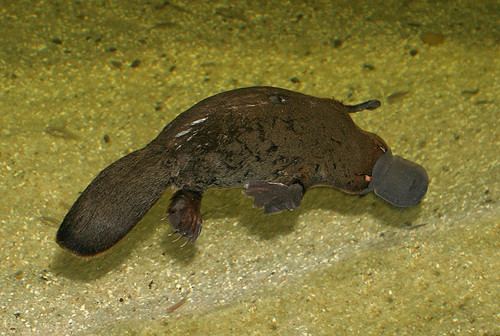
While pouring out the second bottle of the Sparkly, I was reminded that the platypus (pl., platypus), male variety, has a poisonous claw on its rear foot. Photos (not mine).
deuteragonist
The descriptive literary phrase deuteragonist, ˌd(y)oōtəˈragənist, comes from the Greek δευτεραγωνιστης, deuteragonistes, "second actor". Clearly, the deuteragonist falls in importance between the protagonist and the tritagonist in order of importance in a dramatic work; the term also describes the number of lines a character spoke to the audience during the three-actor presentations typical of plays at Attic festivals.
I came across the word in a description of Jacopo Belbo's character in Foucault's Pendulum. It makes perfect sense, but I had never before seen it. A similarly logical word, Deuteronomy, took on almost mystical meaning when pronounced by a particular member of the faculty. He would emphasize that it described the second presentation of the law, and waggle his preternaturally long, tobacco-stained index fingers to indicate "second".