January 30, 2008
As A Man Grows Older / The Confusions of Young Türless
In reading these two novels, I found myself immersed in the psychological turmoil of each book's protagonist.
Italo Svevo's As A Man Grows Older reflects some of the author's fascination with the exciting, contemporary field of pscyhoanalysis. The protagonist, a promising novelist himself, becomes infatuated and involved with a flirtatious woman. In Robert Musil's The Confusions of Young Türless, the protagonist is a pubescent student at a boarding school, caught up in the machinations of both his peers and the school administrators. Both novels explore the dense world inside the minds of people in love, capturing the confusion and anxiety of this complicated sensation. I did not enjoy either book, though, for they were both too inwards-looking for my taste.
A tale of two cities, part three
A concept that I have long favoured for San Francisco may be coming to New York: free transit. Ted Kheel has proposed a "Free Transit Plan (PDF), balancing transit and Mayor Bloomberg's congestion-pricing plan. Kheel's proposal includes convincing analysis of the costs, to the city and to commuters, and he presents his ideas boldly but without hubris. I like it.
Meanwhile, San Francisco's independent auditor has recommended against further study of free transit, citing unbelievably low costs for fare collection and an anticipated rise in ridership. Just six months ago, Mayor Newsom was calling free transit in San Francisco a possibility.
January 29, 2008
In which we go into the fold
Robert Lang writes on origami art and science. He makes mathematical, handsome arthropods from paper.
January 28, 2008
A Briefer History of Time
Stephen Hawking presents an illustrated, clarified version of his A Brief History of Time. This edition presents the enthralling concepts of particle physics, general relativity, quantum mechanics, and other concepts understood by fewer than a dozen people throughout the space-time continuum.
I do love a book in which the author describes physical laws through narration, rather than through explicit derivation of equations. (One exception to this is David Flannery's excellent examination of the square root of two.)
Hawking's presentation falls back a little too easily on a Creator, and does not strongly suggest that physics can indeed solve all problems — as I know it does. Hawking describes moments in which he falls back to the notion of non-physical intervention, specifically at the outset of the creation of this universe. After all, how does one explain the presence of energy that became the matter of our universe? What is the answer to "What came before the Big Bang?"
The illustrations in this edition struck me as kitsch, which at some level is appropriate for a discussion of cosmology, but ultimately distracted me from the useful passages in the text itself.
January 27, 2008
plurale tantum
From Wikipedia: A plurale tantum (plural: pluralia tantum) is a noun that appears only in the plural form and does not have a singular variant, though it may still refer to one or many of the objects it names. Many languages have pluralia tantum, such as the English words "scissors" and "pants", or the Swedish word inälvor "intestines".
Something I have always wanted to know, but never actually did know. Also: The plural of plurale tantum is pluralia tantum.
I found also: Mass noun. I came across these terms while sorting out whether "ox-tail" refers to meat from the same species of animal as "beef" (bos taurus, although I once ate aurochs, and now discover that they were part of an unsettling "back-breeding" scheme). "Cattle" is an example of a word in plural only, with no singular.
I am thinking of aurochs and angels, the secret of durable pigments, prophetic sonnets, the refuge of art.
schraubverschlüsse

I used Google to help me understand the "öffner fur schraubverschlüsse" that I picked up today from the not-quite-a-store, not-quite-an-art-gallery Kiosk. I know that the device, a Monopol Hermetus, can open a beer bottle with a patent top; and, with its rubber gasket, can keep an open bottle, patent or cork-topped, sealed. The schraubverschlüsse opener works on screw tops, which may sometimes act recalcitrant.
January 25, 2008
In which we wonder: art or technology?

I appreciate the skilfull application of colour and symmetry to a project of technology, and wonder: is it art? Beauty, they say, is in the eye of the beholder; lately I have visited some galleries and museums which make me wonder about the optical receptors these people must have, for I see little beauty in a scrap-heap of cardboard on the floor, or a "sculpture" of pasta and glitter, or a piece that looks exactly like the bunch of keys I have in my pocket.
However, I enjoy looking at pictures of neatly-cabled datacenters and server racks, and am thankful that I do not run cable or crimp connectors. Nor shall I, now that slackers has moved out of my closet and into a real colo.
In which we face up to a drunk midget
If your beer keg runs out early, there is probably a drunk midget inside. Recently, I drank the delicious Allagash White ; a couple pints of Bass, the quintessential lunch-time ale; and a satisfyingly stupefying bottle of the Brooklyn Monster Ale, a barleywine with three types of delicious malt (apparently).

January 23, 2008
In Defense of Food
Michael Pollan's In Defense of Food goes to great lengths to explain why we should eat whole foods, and plenty of leafy greens.
My mother's advice, and my parents' general attitude towards food, was "Everything in moderation. Know what you are eating." This assumes that I am both rational and intelligent, which are the same assumptions that Michael Pollan makes.
For the past eight years, I have been keeping a record of what I eat. I am pretty happy about it.
In praise of Blue Bottle
Today, three years after opening their landmark kiosk on Linden, Blue Bottle Coffee threw open the doors to their fully-fledged café in Mint Plaza. Undoubtedly Blue Bottle changed the way I think about coffee, the way I drink and enjoy coffee (which I do, a lot), and my enjoyment of San Francisco. They are one reason that Anna and I made regular weekly visits to the Farmers Market at the Ferry Building.
Although I may not visit the café for some months yet, and have not seen the awesome bronze and glass of the halogen-powered siphon bar they installed. I do like the prospects of a thousand sawbucks' worth of coffee, though! For my part, I am now using a twenty-dollar AeroPress, which looks awfully dangerous but produces a decently smooth cup of coffee. I am not yet convinced that it surpasses a French press for quality or for ease of use, but it is compact enough to keep on my desk at work.
update Not only have a dozen people forwarded the news of Blue Bottle's opening (huzzahs all 'round!), but the San Francisco Chronicle notes that "Miette's Caitlin Williams is on pastry duty."
Pitchfork Rebellious Bitter
Winner of the Gold Medal at 1998's Great British Beer Festival, this delicious and archetypical bitter transported me. The Pitchfork Rebellious Bitter uses single-origin ingredients and is bottle-aged, unlike most bitters I have enjoyed recently (which were cask- or barrel-aged). The hop flavour was distinctively strong; unlike hoppy North American beers, and especially hoppy West Coat beers, I find the hoppiness in bitters more pleasing than [India] Pale Ales.
cow-byre
I came across this word, distinctively hyphenated, in a translation from the German original of "The Confusions of Young Törless". It struck me not only because I had never before seen it, but in using this word -- from the English byre, "a building for sheltering cattle; a barn", the translator's art impressed me. The choice of words in German must also have reflected a certain time, for in these times one would never write "cow-byre" where one might instead write "cow-barn" or simply "barn". A byre might also be a shed or other generic outbuilding, but the emphasis on cow-byre seems unusual and significant. I could not glean the shade of meaning from the context in which the novel presented it, however (and have lost the note in which I jotted down the page number).
In which we restore from backup

Frequent — and easy! — backups accompany all the best software systems. I was perturbed this morning when my telephone crashed, hard enough that it needed a full reinstall and restore. I was happily surprised at how completely the software restored itself: all of the settings, down to the "wallpaper" photograph. Hooray! All I lost was a list of words to look up from the book I was reading yesterday.
January 21, 2008
Edgar Allan Poe
Belatedly, and reminded by fresh news reports of the Poe Toaster, I celebrate the life of Edgar Allan Poe.
In the dead of night, someone came again to the Baltimore cemetery, as happens every Jan. 19. When the figure melted into the darkness, three red roses and a half-filled bottle of cognac were found at the grave site. Once more, tribute had been paid to Edgar Allan Poe, poet and master of horror; born Jan. 19, 1809, in Boston; died Oct. 7, 1849, in Baltimore and buried in the cemetery of Westminster Presbyterian Church. For years — exactly how many is a matter of dispute — a person who has come to be known as the Poe Toaster has made an annual pilgrimage to the site. This year, nearly 150 people gathered outside the cemetery, but Jeff Jerome, above, the curator of the Poe House and Museum, said the toaster was able to avoid being spotted, The Associated Press reported.
The first line I encountered by Poe is cemented in memory: "The thousand injuries of Fortunato I had borne as I best could ; but when he ventured upon insult, I vowed revenge." The story that unfolds in The Cask of Amontillado has chilled and enchanted me as no other. Although Poe's poetry and stories have all gripped me, none has stuck in my mind as much as this, with its passionate dialogue and diabolical, calculated protagonist. I read it just after starting primary school, and I wonder (now) how one explains jokes about Masonry to eight-year-olds. In those days, each new story or poem I read offered beautiful new vocabulary: niter, flaçon, roquelaire, motley, and the hypnotic plural flambeaux.
John Stewart
John Stewart died today. Widely known for his work with The Kingston Trio, he also produced four dozen solo albums.
He also wrote (and sang, on the canonical Monkees recording) Daydream Believer, one of the most pervasively catchy sugary pop songs ever.
January 20, 2008
Last Night at the Lobster
Stewart O'Nan's Last Night at the Lobster presents the poignant story of closing night at a Red Lobster restaurant in a Connecticut mall reminded me of a story by David Mamet, and of the movie Reach the Rock. The author quickly drew out the characters, delineating their relationships and their habits, and let the quotidian events unfold.
One sees the inexorable arc of the story from the first page, but O'Nan's narration allows it to unfold at a welcome pace. He treats the story and the characters with respect, allowing their thoughts and their voices ample space. He gives plenty of room to the manager Manny DeLeon, the romantically-ambivalent protagonist, from whose limited third-person perspective we see the last night at the Lobster. Everyday events at the restaurant give Manny the occasion to contemplate and to reflect. He tries sincerely, if naïvely, to make the day's events perfect for the remaining staff and for himself. The novel is a pleasant, quiet presentation of dignity and everyday people.
January 19, 2008
In which we have a few familiar beers
A couple pints of North Star Brewing's excellent Blue Star Wheat, a delicious beer to drink cold and with a meal (oysters! deep-dish pizza! a meatball sandwich!); a bottle of Southampton Publick House's superlative Double-White Ale, a wheaty Belgian-style wit, which is one of my favourite beers, at least a favourite amongst what I have tasted in the past year; a Duchesse de Bourgogne, a potent and sweet Flemish "red" ale that comes in a distinctive, demure brown bottle; a Hinano, from French Polynesia — the exact opposite of a local brew, and one I am not quite certain I should have ordered. The standouts are the Blue Star Wheat and the Southampton, but those are both ringers, as I have enjoyed them before.
The Duchesse merits a warning: drink with the appropriate meal, as the thickness of the beer and its sweetness both make casual sipping difficult. Pairing it with a pork roast or other mild meat would balance it.
January 18, 2008
On maps
An image that maps each state in the Union to its counterpart in GDP, showing the formidable economic power of the United States.
Upon checking in to a hotel a few days ago. I arrived in the dead of night, and the night clerk was reading a slim volume with an attractive cover. I eyed it while we went through brief formalities, and then asked about it. An Atlas of Radical Cartography: turns out that I know the editor, if slightly, through Lize Mogel's excellent map of green space in Los Angeles. I spotted this map several years ago on a bus shelter near the Farmers Market at Third and Fairfax, and subsequently obtained a copy.
January 17, 2008
Dead Tech, Or, On Decaying Machinery
I recently found an edition of "Dead Tech" reprinted by the excellent Santa Monica booksellers Hennessey and Ingalls. This book presents a series of photoessays on decrepit, abandoned, obsolete, rusting infrastructure around the world: quietly rotting piers in Manhattan, factories in Germany, the quietly beautifulTucscon Boneyard. The latter collection of old United States Air Force craft resides at Davis Monthan Air Force Base, and the pieces slowly parted out to other planes, or sold for scrap. The precious-metal content of a single old Pratt & Whitney spark plug is in the hundreds of dollars, for the gold and platinum within; meanwhile, the shells and fuselages of the airplanes sit in the desert sun.

The Dead Machinery community on LiveJournal has an excellent photo pool of everything from rusting Soviet tractors to the insides of old steel mills. Photographer Mark Perrott published an excellent photoessay, Eliza: Remembering a Pittsburgh Steel Mill, on the Jones & Laughlin blast furnace. A series of photographs on flickr show the remnants of jets in Arizona and in California.
January 16, 2008
scorbutic
scorbutic means "afflicted with scurvy", a terrific word (and one I am surprised I never saw before in Captain Haddock's irascible vocabulary). I knew it from the Italian adjective scorbutico, meaning "irritable, grouchy", but had not yet seen it in English; when I saw this word on today's A.Word.A.Day I had a sudden realisation of its familiarity.
January 15, 2008
18th and Valencia / Steiner
Walking past the vacant lot at the corner of the 18th and Valencia, I saw a woman stooping to scoop the poop her dog left along the chainlink fence. As she stooped, a voice said, "You don't need to clean that up." (You do.) The voice came from a disheveled young man sitting on the sidewalk, a few feet away from the poop. This photograph, misleadingly, is from Steiner between Haight and Waller.

New York City's famous 1978 Pooper Scooper law certainly set a standard, but how and why is it more well-enforced than similar laws in San Francisco?
On a related note, the fine folks at Blue Bottle Coffee note that even new developments in San Francisco are prone to mediaeval nastiness: "Some time between Thanksgiving 2007 and the closing ceremonies of the Beijing Olympic Games, we will be opening our first café! We will be opening on a formerly pee-smelling alley on the corner of Mint and Jessie in downtown San Francisco now excitingly called Mint Plaza. We will be serving toast, a few snacks, maybe a glass of wine in the evening. Oh, and coffee." Mint Plaza, once a Golden Gate Transit turnaround, now an urban oasis!
Note: two years earlier, during the same large event in San Francisco, another New Yorker made a similar observation.
January 13, 2008
Brooklyn and beer
I have always enjoyed visits to Brooklyn, but have never quite felt at home in this, New York's most populous borough. This week, I had several bottles of the environmentally-minded Brooklyn Brewery's Lager, Pilsener, and Pale Ale. All reasonably tasty beers, but none of the subtlety that I have come to enjoy in craft-made beers. I have found that bottled beer really does taste less excellent than the same beer from a tap or cask; sometimes beer bottled in small batches, or purposely bottle-aged, will have characteristics that elevate it past other bottles, but generally bottled beer has become less exciting.
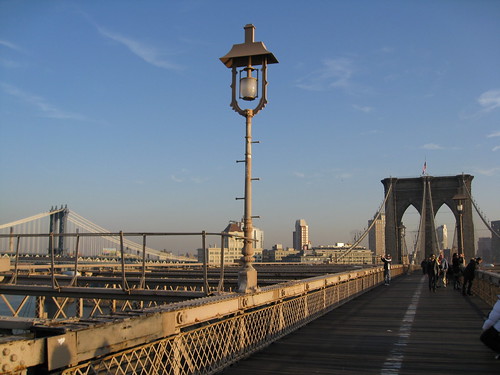
Brooklyn, however, remains intriguing. There are several good places to have beer, as well, although Spuyten Duyvil (Williamsburg, not Inwood) stands out amongst them.
In which I turn pro
You don't have to be weird:
I don't know why I only looked for "The Fall" on YouTube now, but a trove indeed lies within. The Fall colour more of my memory than any other band, I think, from discovering "Live at the Witch Trials" (and the cover of Belle and Sebastian's If You're Feeling Sinister always reminds me of Live at the Witch Trials, not of The Trial), to obliquely bumping into Brix in college, to finally seeing them perform in concert for the first time (after years of swapping cassettes, — yes, cassettes — over Usenet), to chatting with a Kiwi who walked past the stoop only to find that he was their number one, yes, indeed, he was at the recording of Fall in a Hole. It's like that, see: The Fall bring people together.
Big New Prinz and Cruisers Creek.
I should also note that this morning, while waiting for a table at a popular bar-café, I asked the barman (at the four-seat bar) for a drink. A slightly greying man came back inside from smoking a cigarette, saw the barman pulling out a small jar of pickled pearl onions from a corner of the bar and remarked: "Must be an old-timer in here. No-one orders drinks like that," and looked around -- expecting what? someone rail-thin and in a three-piece, a slightly worn fedora atop a mostly bald pate? A comfortably portly man of prosperity, a well-loved tweed jacket over baggy trousers? And saw me, chuckling at being called an old-timer. The greying man went on to say that the Gibson is a great drink, and we agreed that it was good for mid-day (check), sunny weather (check), early afternoon (check), in fact, just about any time. "My father used to make those," he said.
January 12, 2008
Harvieston Bitter and Twisted Ale

The Harvieston Bitter and Twisted Ale is a delicious ale, served in a wonderfully tall pilsener glass. I had it after an imperial pint of the Chelsea Brewing Company's Winter Wheat from the cask at Jimmy's.
The photograph has nothing to do with beer other than that I like bridges and beer both.
January 11, 2008
In which we consider a museum

Briefly: I heard Robin Nagle of NYU talk about the history of the New York City Department of Sanitation.
More soon.
January 10, 2008
Grotten Brown
Pierre Celis has his signature on this bottle of a Brown Ale. The Brown is not a type of beer I associate with Belgian brewers, but the labelling might be special for the States.
This particular bottle yielded a pleasant, strong ale, but not extraordinary, and not on the same level as the other beers from St Bernardus -- who make an especially nice Wit. I ate it with a baguette and some cheese, but think that I could have done better in terms of the ale itself.
January 9, 2008
√2
David Flannery's book √2 is a beautiful explanation of the properties of this irrational number, presented as a dialogue between a master mathematician and an eager student. The dialogue is in the tradition of Socrates, of Galileo; it is an explication of a sublime concept, presented clearly and logically, with succinct interludes of history and anecdote. I learned more about the symmetry of standard paper sizes in Chapter 2 of this book than I ever thought I might encounter!
This book uses an alternative spelling of minuscule: miniscule. Perhaps the result of years of pervasive mis-spelling, many dictionaries now present this spelling as a variant of the original. As a fan of alternatives, I appreciate this; however, the vowel shortening alarms me. Aside: I notice "break" commonly used to indicate the mechanical device used to stop cars, elevators, trains, et c.; will this, too, become an accepted spelling?)
Both the author's approach and prose make for a much more enjoyable read than either of the volumes I read (or tried reading) on 0; or π; or e. I really enjoyed this dialogue, and the genuinely useful illustrations and algebra. The final chapter, "Odds and Ends", presents some of the more engaging problems of number theory, including a demonstration of taxicab problem. The discussion and proofs of Pell's Sequence uses simple, clear algebra to show the increasingly-accurate approximations of the square root of two; the awesome power of the Heron Sequence becomes apparent as the dialogue reveals how to rapidly advance through the approximations in Pell's Sequence. The inherent beauty of the numbers is dazzling (although I would stop short of describing some of the algebra as "witchcraft", as does the Teacher in this dialogue).
In which we have some language lessons
The New York Times Book Review had an all-Islam issue on Sunday, with an interesting essay on learning Arabic by the Times's Beirut bureau chief, Robert F. Worth. I have been studying Arabic intermittently for the past few years, and many of his observations ring clear and true.
For anyone who knows only European languages, to wade into Arabic is to discover an endlessly strange and yet oddly ordered lexical universe. Some words have definitions that go on for pages and seem to encompass all possible meanings; others are outlandishly precise. Paging through the dictionary one night, I found a word that means “to cut off the upper end of an okra.” There are lovely verbs like sara, “to set out at night”; comical ones like tabaadawa, “to pose as a Bedouin”; and simply bizarre ones like dabiba, “to abound in lizards.” Dabiba (presumably applied to towns or regions) is medieval, but I wouldn’t put it past Dr. Zawahri to revive it....
At the same time, all Arabic words have simple three- or four-letter roots, with systematically derived cognates that allow you to unfold a whole range of meanings from a single word. The word for “to cook,” for instance, is related in a predictable way to the words for “kitchen,” “dish,” “chef,” and so on. Arabic speakers are often dismayed to discover that the same principle is less common in English.
As the months passed, the sounds of the language were gradually transformed. Arabic’s hard “h” letter, so difficult to pronounce at first, began to seem like a lovely breath of air, as if countless tiny parachutes were lifting the words above their glottal base. The notorious “ayn” sound, which often takes months for English speakers to produce, lost its guttural edge and acquired, to my ear, the throaty rumble of a well-tuned sports car.
Like the author, when I first began learning Arabic I tried out my meagre conversational phrases on everyone I could, but my enthusiasm tapered off as I realised that I could sustain very little in the way of constructive dialogue. Sure, I could ask after the health of obscure relatives (the vocabulary for family is very rich), but I could not easily understand the answers, especially if they were spoken fluently. I was very surprised a few months ago when, sitting in the front seat of a downtown-bound cab, I not only got the gist of our cabbie's conversation, but understood entire sentences. His Arabic was remarkably clear and dialect-free, and he must have hailed from the Levant (alas, the group with me in the cab were all hurrying to catch a ferry, so I could not stop and make chit-chat with the driver).
January 8, 2008
Big Bang
Simon Singh presents an eminently readable history of cosmology, the search for order and explanation of the universe.
His narrative, filled with anecdotes and adventures, enthalled me. I carried the book around for days, savouring it. The story pulls in the snipes Newton took at Hooke, the poor hunchback; the salacious details of Brahe's life; the disappointment of duplication that Alpher and Gammow felt (and Gammow's delightful doggerel, often at Fred Hoyle's expense), and many more. All of these personal details add colour and depth to the already-thrilling story that unfolds as scientists attempt to explain through reason and deduction what they observe. Never before have I grasped so clearly the achievements of observational astronomers, whose painstaking and beautiful work has led us to so detailed an understanding of the beginnings of time and space.
Singh puts forth the story clearly and at a very moderate pace. He explains scientific theories brilliantly, simplifying as necessary and carefully relating each new theory to the others. He also uses math effectively, presenting constants in clear narrative context; the end of each chapter also has a two-page summary, which gave me an excellent opportunity to review what he had explained and to make sure I got it.
Big Bang is one of the best books I have ever read. Had I read it fifteen years ago, I probably would have my head in the stars at this very minute.
January 7, 2008
In which I begin to understand
During a visit to the Dia Arts' Riggio Galleries in Beacon, I discovered the work of Michael Heizer in person. I had read about his ambitious terraforming earth sculptures and heard about his Levitating Mass (link goes to overview and criticism of public art in New York City).
The ubiquity of satellite imagery on the Internet allows us to peek at Michael Heizer's City, a work in-progress in Nevada. Heizer has not made the work widely available to the public, and looking at aerial photographs feels like something of a spoiler; I shouldn't have looked for it. Heizer expects to complete City in 2010, but visits to its remote location might be as tricky as seeing his contemporary Walter de Maria's Lightning Field or Robert Smithson's . All of these pieces also receive support and curation from the Dia Foundation. The Foundation, long a supporter of visionary installation art, takes its name from the Greek δια, meaning "through": "chosen to suggest the institution's role in enabling extraordinary artistic projects that might not otherwise be realized."
After not quite understanding two holes-in-the-ground, one at the Tate Modern and the other until recently at the Gavin Brown Gallery in New York, seeing Heizer's North, East, South, West, 1967—2002 at dia: Beacon caused my jaw to drop. Beholding the installation in its context revealed the art as transcendent, and seeing several galleries of similarly massive, innovative works was an epiphany. I need to go back to the Warhol Museum.
All the exhibits at the dia: Beacon have developed with the collaboration of the artist, or with the artist's intellectual trustees. Gerhard Richter's grey mirrored panels appear in a beautiful rectangular gallery, lit by a glorious clerestory; Joseph Beuys's energy-channeling Fond series is in a sombre, dim room, and Dia has installed his Aus Berlin: Neues vom Kojoten in a room built to the specifications of its original début. Seeing galleries of such organization brought remarkable clarity to the works. One specific experience: walking in to the massive central gallery, ringed with isomorphic canvases in Andy Warhol's Shadows series.
January 6, 2008
In which I put on my Saturday suit
In the past few days I have been walking about, enjoying the mild weather in the form of a leisurely stroll punctuated with refreshing pints. Standing out amongst the pints is O'Reilly's Stout, from Sly Fox. This Excellent! Spectacular! Irish stout has a mild, toasty taste tempered with slight sweetness. With 3.6% ABV, it certainly goes down easily; it suits a meal wonderfully. I also enjoyed the Riggwelter Yorkshire Ale, heavier but also pleasantly sweet on the tongue; the barrel-aged Allagash Curieux, a tripel aged in a cask with a bourbon heritage; and a "Winter" Scotch Ale, probably from Canaster. This mysterious, heavy, and dark ale had more than a touch of sweetness, but is a very well-balanced beer.
I had several bottles of the Ommegang Hennepin, and found that it improves as it breathes. While keeping the bottle cool, a little air does something quite nice to this saison-style farmhouse ale. Wheaty in complection and flavour, the sparkling taste of the hops fades as the bottle remains open; this results in a very pleasing taste on the tongue. The Hennepin is a bottle-aged ale, and pours with a thick frothy head that would make a Belgian bartender proud.
January 5, 2008
North Henry and Greenpoint Ave
imnotsayin has a useful summary of the Newtown Creek Water Pollution Control Plant's renovation. In light of what I learned while reading Elizabeth Royte’s Garbage Land last year, most of New York City's solid waste comes through the sewer system to these plants. The plants also separate and treat the waste that flows through the storm drains, except when the volume would overwhelm the treatment facilities: it then flows out into the Harlem River, the Long Island Sound, and the East River (I think), untreated. The solid waste, once separated from the fluid, becomes fertilizer for orange groves in Florida.
The summary's author posted some excellent photographs of the Newtown Creek facility. The photos show off the beautiful tiles, especially the dominant green, that drew my attention to the plant in the first place. My photographs did not come out with such clarity, alas!
In which I see arctic technology

The photography of Christian Houge, now in his first State-side show, at the Hosfelt Gallery, made a huge impression on me. He captures the hues of snowy landscapes marvellously. He combines the quiet natural beauty of Norway with the stark colours of man-made antennae.
There is an island located between Greenland and the North Pole called Spitsbergen or Svalbard (“the cold land”). The seclusion of the island results in its having the cleanest atmosphere in the world and being one of the best places to do astronomical, meteorological or climate research. Hence, the remote and pristine landscape is marked by installations of technological and scientific equipment.
The photographers who have most excited me all combine specific mechanical or technological elements in their work: O. Winston Link, who photographed steam railways; Edward Burtynsky, who photographs 'infrastructure' and especially strip mines and ship-breaking yards; and Christian Houge, capturing the systems used for searching the skies.
January 4, 2008
W 36th and 10th Ave

Just as it looks: a smash-up with the NYPD on one side, and a "Traffic" van no less. Must have made a pretty sound, with the amount of shattered headlamp plastic everywhere.
E 55th St and 2nd Ave

January 3, 2008
Blue Point Hoptical Illusion
I had tasted this from the cask at Heartland Brewing's ridiculous (in the stupid sense) summer brew fest, and it had a nice taste; from a cool bottle, it comes across hoppier and crisper, but suits the agèd cheddar and fresh demi-baguette I had with it for lunch.
This IPA suits my palate: it is not hopped over-the-top, as many American IPAs are these days; nor is it too bitter. The hops come from the Pacific Northwest, home to many (most?) American hops; the Blue Point web site suggests that they are the sole brewers using this hop. Blue Point are becoming my favourite overall New York producer!
In the sculpture garden of the philosophers
"Garden of the Philosophers" is the phrase I should use to describe Socrates Sculpture Park, a City Park, at an attractive corner of Long Island City, Queens. Walking into the park felt akin to a stroll in a junkyard, complete with a Beware of the Dog sign (and actual frothing-at-the-mouth dog, protecting its rusting iron heaps. Was this also art?). The park area had several fresh-looking pieces as part of the Emerging Artists Fund 2007 annual exhibition, but several had begun to age unnervingly from the weather, and others looked too confusing to be outdoors (an oversized Christmas decoration might be kitsch, but art?).
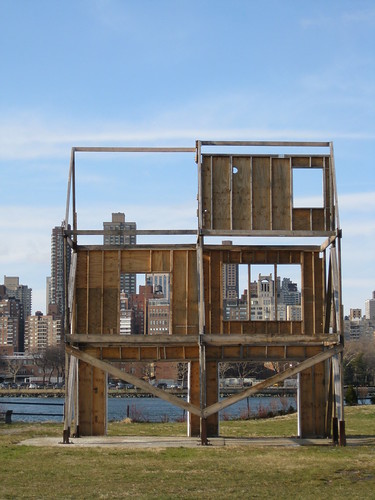
I took some photographs, now that I am back in the habit of carrying my pocket camera. The sculpture I enjoyed the most was a series of steel posts about five meters tall, with a rotating arm that swung with the wind and periodically hit a bell with a weight. I have never liked wind chimes, but this shining sculpture captured my attention.
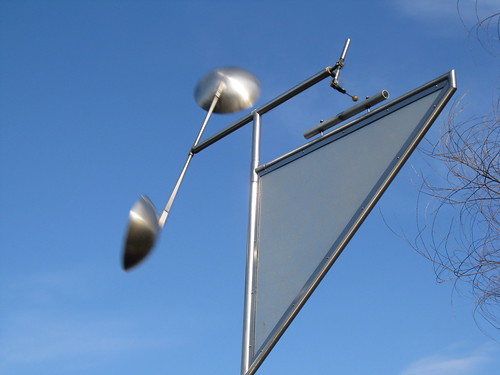
The cups on the East River side of the sculpture catch the breeze, turning an axle connected to a short tube with a weight at one end. The weighted side of the apparatus completes its revolution independently of the cups, and the weight itself is on a hinge, so that it only occasionally hits the hollow tube mounted above the stationary triangular fin. The sound is quite lovely.
Thanks in part to the proximity of the Museum of the Moving Image, the Garden hosts annual outdoor film screenings. Where does the name "Socrates" come from? The Park Department's web site is strangely quiet on this. The park's web site notes that sculptor Mark di Suvero led its creation in the mid Eighties, around the same time that the City of Pittsburgh was agonizing over the installation of one of his monumental outdoor sculptures on a traffic island downtown.
Chelsea Brewing Stout
Today I had a delicious, malt-edged stout from the cask at the Ginger Man: the Chelsea Brewing something-or-other, which I did not write down and cannot find on their web site -- I suppose a return trip to the pub is in order.