February 29, 2008
In which we have not staunched the flow
mattymatt, writing on sfist.com, has a handy chronology of TransLink. This is why the Bay Area will never host an Olympics event.
Oh, yes: I love belly-aching about TransLink. I even see OysterCard-style smart-card readers on some of the vandal-proof MTA turnstiles these days, and wonder down which road we are heading: MasterCard sponsors the system.
February 28, 2008
In which I smell a rat

The sight of a rat in the subway fills me with joy, not horror. I have a superstition: a rat augurs well. I especially enjoy the sight of a rat gambolling along the tracks late at night, in the utter silence of a quiet subway station.
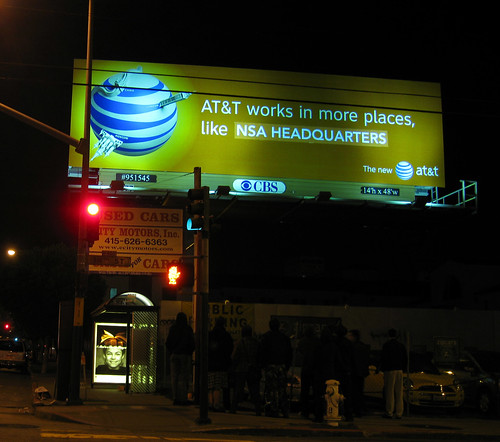
In which a photograph is worth a thousand wiretaps
The Billboard Liberation Front helps put things into perspective.
February 27, 2008
On finding and sharing over the Internet
I enjoy reading both passive-aggressive notes (especially this fine example!) as well as mis-cased &mdash not merely mis-spelled! — posters.
Of course, I also enjoy puzzling puctuation, grocer's apostrophes, and signs showing food eating itself.
February 26, 2008
On tits and ass.
Did Apple make a clbuttic mistake? Whose conbreastitution does President Bush trample? Whose parish buttets are up for sale?
Although spell-checkers are a boon, arbitrary use of global replace can be devastating. Take it from me, who removed all of the us from a client's web site some years ago.
February 25, 2008
Testing, Or, TransLink
A photograph is worth a thousand words:
 (via)
(via)I have written previously on TransLink: 2004, 2005, 2006, 2006, 2006,2006 (I think I gave up, eventually).
February 22, 2008
Twinkie, Deconstructed
Twinkie, Deconstructed was a surprisingly difficult book to finish. The author's premise fascinates me: investigating each of the several dozen distinct ingredients in the Twinkie snack cake (that phrase alone makes me shudder).
The writing made reading the book painful: the text is rife with mis-spellings and poorly-chosen phrases, and has an abundance of commas, often where instead a semi-colon or colon is appropriate instead. The book also confuses the reader by introducing jargon tens or hundreds of pages before actually defining the phrase or using it in context; I had to look up Maillard reaction after re-reading a chunk of the book to see what I had missed (nothing), and ultimately found a definition towards the very end of the book.
Despite the poor editing, Steve Ettlinger tackles a tricky topic with aplomb. His investigation takes him into the bowels of the earth, through monumentally large factories, and into areas made for the industry of food production.
By arranging the book so strictly along the ingredients, Ettlinger misses some intriguing connections amongst the processes and ingredients: security, petroleum, and food science. He mentions the importance of protecting the food supply ‐ food colouring especially at risk — from antagonists, but does not discuss what might happen or how; he does not discuss how so many of the ingredients, refining processes, and transport of the Twinkie require crude oil; and he misses out on explaining how and why so many emulsifiers, preservatives, and anti-caking agents fit together into the diminutive snack cake.
February 21, 2008
February 20, 2008
petitio principii
Authors and orators often use the expression "beg the question" to mean "This brings up the question ...". This is wrong: to "beg the question" means to assume, incorrectly, in order to make a point. The wikipedia has a section "Modern Usage controversy" in its entry, but reduces the problem to pitting prescriptive grammar against descriptive. Being a stout prescriptivist, I disagree: the damn phrase has a specific connotation. Mis-use of this phrase, especially by those putting on airs, irritates me.
February 19, 2008
Fidel Castro!!!
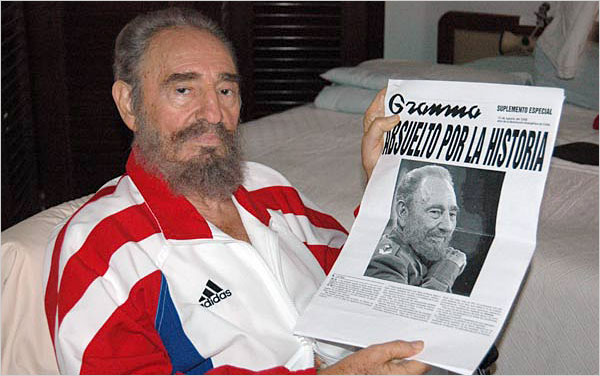
To borrow from another playbook: I mean Fidel Fucking Castro!!!
I get really worked up about Cuba, partly from my romanticized notion of how the socialist ideal has played out. I saw Mikhail Kalatozov's Soy Cuba and fell in love with the stories, the colours, the tracking shots; I read Graham Greene's Our Man in Havana and thought about the intrigue of the island. The photograph and implied capitalist-style product placement come from The New York Times.
Rumpole and the Penge Bungalow Murders
I picked up this volume over a collection of short stories because the title sounded appealing; I had never before read (nor seen the famed television series) Rumpole's exploits, as chronicled by John Mortimer. The story turned out dull, with the ending telegraphed from the get-go: not only the general outcome, but even very specific details, were patently obvious quite early in the narrative. The cast of characters, a hidebound British barrister's Chambers, has not quite the appeal of Sarah Caudwell's modern group of barristers. Rumpole himself is writing his memoirs in this book, and much of the action happens long in the past; this may be atypical, or too late in a series familiar to many readers, but the setup is slightly confusing, and contains altogether too many condescending remarks to his now-wife and to their relationship. These remarks may be hallmarks, rather, of the dry British wit.
The murder story itself is uninteresting, and devoid of technical details (as I, a fan of Dorothy Sayers and Conan Doyle, appreciate!) and the trial features dull repartee between the Lord Judge and the "white-wig", or newly-called-to-the-bar, Rumpole. The book was not engaging enough that I read it in a sitting, as I often do with thrillers or mysteries.
February 18, 2008
In praise of the semi-colon
The New York Times writes in praise of the semicolon, as found on a placard on MTA trains.
It was nearly hidden on a New York City Transit public service placard exhorting subway riders not to leave their newspaper behind when they get off the train.
"Please put it in a trash can,” riders are reminded. After which Neil Neches, an erudite writer in the transit agency’s marketing and service information department, inserted a semicolon. The rest of the sentence reads, “that’s good news for everyone.”
Semicolon sightings in the city are unusual, period, much less in exhortations drafted by committees of civil servants. In literature and journalism, not to mention in advertising, the semicolon has been largely jettisoned as a pretentious anachronism.
This particular semicolon has aggravated me, perhaps because I prefer staccato sentences in advisory signs. This sign's exhortation becomes more of an admonition with the sentences split that way; the semicolon becomes a lengthier pause than a period, because the reader may have to read the following clause, and then re-read the entire sentence in order to parse it properly. The sign does have sophistication; I give it that. As for the New York Times: I am happy that they, despite their plummeting level of sophistication, printed this piece.
February 17, 2008
In which the spirit of free enterprise rises
Aram's gig is online, or will be, soon. I wonder if he will recreate those beautiful stamped-metal business cards I last saw him handing out on our back porch on Kimbark Street just before it became Allan's bedroom for that summer.
Word is that Gordon has a new shop, too. Word!
February 16, 2008
The spirit of socialism is all over the internet / The Vertical Color of Sound
Eric Tamm's magnificent study of Eno is officially and freely available online (download the zipfile). Although most writing about music is like dancing about architecture (a witticism attributed variously to Frank Zappa, Elvis Costello, and Laurie Anderson), Tamm brings history and perspective to Eno's inventive notions about the development and creation of music.
Eno's own liner notes to his 1975 composition Discreet Music include an excellent explanation of his process in treating Pachelbel's Canon in D; three of the resulting pieces form the B side of the album.
February 15, 2008
A few thoughts on elevators
Elevator-simulation software uses concepts from the field of discrete event simulation. I am not familiar with the algorithms used, but have read about systems used for these simulations.
One thing I wonder about whenever I ride an elevator: why do the floor-selection buttons not cycle through on and off?
(compare to:
)
I know that people find psychological relief from repeatedly punching elevator buttons, expecting that the additive effect of these pushes will make the elevator move faster.
The sudden transition from subway and the horizontal motion to the elevator and its vertical movements sometimes jars me, especially on mornings when I take the train directly to the office building, and expect a jarring forward motion to accompany the closing elevator doors.
February 14, 2008
In The Aeroplane Over The Sea
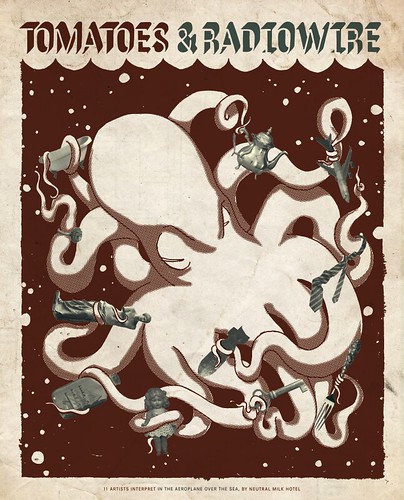
This week marks the tenth anniversary of the Neutral Milk Hotel album In The Aeroplane Over The Sea. I would not have noticed were it not for coming across a crisp cover of the title song and following links.
The Lazy Catfish presents video interpretations of the album this Thursday at nine o'clock; the poster above is the advert for the gig.
February 13, 2008
A few words on the subway
While riding the rush-hour subway northwards a few evenings ago, I overheard a few medical students talking about how they would rather be in a car, or on the shuttle, but the subway was faster. As we progressed northerly, more and more people crowded in to the carriage, and the medicos pressed together, joking about how tight the space was becoming. One asked another about a syndrome in which people derive physical pleasure from pressing up against others in crowded area, and pronounced it "frawternize", somewhat along the lines of "fraternize" but distinctly different in its first syllable. I could not find references to the word online, and wonder if the M.D. wasn't joking for the sake of eavesdroppers, but am curious.
The MTA announced its trip planner, which looks a sight nicer than HopStop, and is speedy.
February 12, 2008
Wordcraft
Wordcraft is Alex Frankel's examination of the business of branding: of finding words, creative slogans, and stories to express a brand's identity.
He presents five case studies: BlackBerry, Cayenne, Accenture, Viagra, and IBM's e-business, each peppered with anecdotes and solid first-hand reporting. The studies veer between business journalism and language commentary; Frankel's practical, straight-forward prose makes them easy to read and to follow. Although far from thrilling, this book was much more informative about brand development and identity than Dana Thomas's Deluxe, and provided more insight into why people want to identify with a brand. It's cool to think that you are part of the same consumer experience as your favourite sports figure, motion-picture actor, or politician ("Bob Dole knows a thing about Viagra.").
February 11, 2008
gunnel
Gunnel, /ˈɡʌnəl/
gunnel is a nautical term describing the top edge of the side of a boat; it is synonymous with gunwale. The word may come from weal, the ridge formed in a skin injury, but more likely comes from wale, a plank. Hi, Erik.
February 10, 2008
Traquair
Traquair, The "House Ale ... of the Oldest inhabited House in Scotland", is a fine malty beer, heavy without being sweet. It pours cleanly with a small thick head, and only make its fruity sweetness apparent in concert with its maltiness.
Delicious stuff, excellent for a cold wintry evening (the first with snowfall, all season!).
February 9, 2008
In which we go to school*
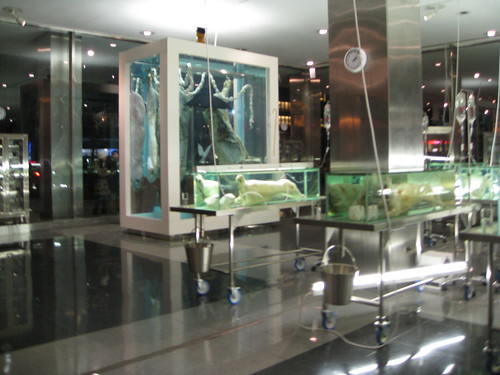
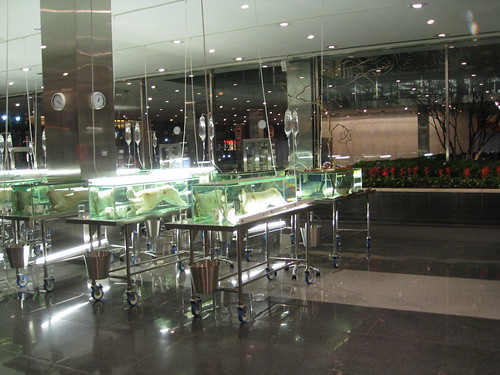
School: The Archaeology of Lost Desires, Comprehending Infinity, and the Search for Knowledge
February 8, 2008
In which we rock out to math
Math and music, but not math rock: "Guthrie's daughter Nora eventually figured out that the [mess of wires] wasn't a bomb, but rather a recording of her father on a device that predated magnetic tape. After a year of searching, she managed to track down someone with the equipment to play it."
"Fortunately, math can help. Howarth had developed algorithms to correct these recordings. He looks for extraneous sounds, like an air conditioner or fan in the background that creates a rhythmic sound. Instead of simply removing these sounds, he uses them as a clock, a kind of built-in foot-beat in the recording that tells him what the true timing should be. When a recording is made, this background rhythm is even. But when it's played back, it speeds up and slows down in perfect timing with the errors in the recording. That allows Howarth to adjust the timing of the recording to make it much more similar to the original sound."
February 7, 2008
J K Scrumpy Hard Cider
For the past several months, I have been enjoying New York State apples in the form of Doc's Hard Apple Cider. Facing the long cooler at the grocer's a few days ago, I instead picked up a bottle of J K Scrumpy's, a hard cider from Michigan. The difference between the two is huge: Doc's is dry, tart, and crisp; Scrumpy's is sweet, bold, and sits heavily on the palate. Scrumpy's tastes like what apple juice tastes like, but has alcohol; it is too sweet to enjoy except perhaps in small quantities.
The International Beer-Mapping project will come in handy at home and abroad.
February 6, 2008
Deluxe: How Luxury Lost Its Luster
Dana Thomas's Deluxe, sub-titled "How Luxury Lost Its Luster", an exploration of brand-name fashion, disappointed me: I was looking for a deeper cultural history, one that would explore the connections consumers have with marks and brands.
Her research focuses entirely on modern and contemporary fashion, and almost exhaustively so. Her presentation of the history of various houses, such as Chanel, Herm�s, and Louis Vuitton does dig into the social aspects of their creation; she avoids the ingrained aspects of our desire for specific luxury goods. She hints at this when she makes a contrast between Herm�s, which does not ostentatiously brand its clothing with its logo; and Gucci, which does.
I have a vague recollection of some Aristophanic humour involving slaves who came from the wrong trader, but on the other hand the joke may have only been in an Asterix comic. The desire for association with a well-known purveyor certainly dates back far into history.
Aside: "the quality guarantees the brand", as Lord Peter Wimsey pointed out in Murder Must Advertise.
February 5, 2008
brume
A word meaning "mist" or "fog", brume comes to English from Fr., whence Old Fr., perhaps from Provençal; ultimately from Latin brūma, winter; I wonder why I have never seen it before, as it is so pretty and expressive. I read it in a New York Times article on the Morgan.
February 4, 2008
Stout, stout, stout, stout
Stout is one of my favourite beers, although one particular beer represents the genre so strongly that it has become synonymous with "stout" (for Irish stout beer, I much prefer Beamish!). Stout tends to be slightly sweet, with its the warm taste of toasted malts or barley accompanying the syrupy alcohol. I sat down recently and drank a few more pints of the Sly Fox O'Reilly's Stout, one of the most outstanding stouts I have enjoyed. I then leaned into a pint of Young's Oatmeal Stout, and thence a bottle of Sam. Smith's Oatmeal Stout; these two have thick, dark heads with creamy tastes. I later had a bottle of Samuel Smith's Imperial Stout, which has a thin but heavy head and a dense array of flavours."Imperial" stout has more alcohol than most stouts, for fortifying it against travel; it sometimes has the label "export".
Sheldon Brown
Sheldon Brown died last night. His writings on cycling, photographs of his bikes and exploits, and peerless attitude towards creating community will live on.
Several years ago, I made a detour in to the Harris Cyclery to see just where this man held court. Sheldon "CaptBike" Brown was the personality that characterized all that is good about cycling and about community. In an era of instantaneous, plentiful communication, he had a distinctive and constructive approach to writing email; he posted excellent, informative essays on practical and technical aspects of cycling on his web site; and his many other interests revealed him to be a lively, loving man.
February 3, 2008
In which we have science without tears
New Zealand: ‘No Tears’ Onions
By AGENCE FRANCE-PRESSE
Published: February 2, 2008
A New Zealand concern called Crop and Food Research said on its Web site that it had created a tearless onion by turning off the gene that produces the enzyme that causes a person slicing an onion to cry. It hopes it can hit the market within a decade. The breakthrough was featured in the December issue of Onion World, the international onion trade journal.
A picture (well, screenshot) might help:
February 2, 2008
Over the Edge of the World
Voyagers in the Age of Discovery trained in formal schools, where they learned the science of navigation, theories of cartography, and the immense trove of history essential to understanding of exploration. In Castilian Spain,the Casa de Contratraci�n's "School of Navigation [provided] formal training [to] pilot[s], probably from the boastful and controversial Amerigo Vespucci .... Students received credit in the form of beans won from their instructor; if they successfully completed a course, they were awarded a dry bean; if unsuccessful, they received a shriveled pea." Casa de Contratraci�n was the "House of Commerce", and provided the financial backing for the highly-speculative and incredibly dangerous voyages to the Spice Islands.
Contrast this to the school in William Langweische's Outlaw Sea, which involved real-world simualations in the South of France, complete with scale-model ships of all varieties.
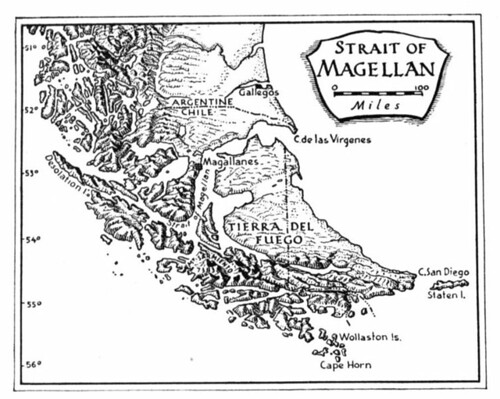
Laurence Bergreen's story of Magellan focuses on his monumental 'round-the-world voyage. Leaving much of Magellan's early story behind, he paints a portrait of a barely competent navigator whose luck and hardheadedness combined to take him most of the way around the globe. Although Ferdinand Magellan's expedition and its findings (yes! the world is round!) are tremendous, they now seem to me more the result of chance than of calculation. Magellan did not have an aptitude for scholarship, and was no master of instruments; his cosmologist collaborator went insane before the ships sailed. He faced many political obstacles, both in the Portuguese empire and in the Spanish court of Charles I, and showed little aptitude for handling the intrigue. . The book itself starts slowly, but once the voyage is underway the excitement begins: cannibals! giants! williwaws! mutiny! exotic islands! spices!
update I plumb forgot one of the other exciting passages of this book: Bergreen recounts the punishments that the hapless Magellan metes out in revenge for the first mutiny, and describes a form of torture especially beloved by the Spanish Inquisition. Torquemada was as fond of waterboarding as are the United States Attorneys General. Even as he engaged in the clear acts of torture, Magellan knew that he would receive dishonor upon his return to Spain. Five hundred years later: Plus ça change, plus c'est la même chose.
February 1, 2008
In which high taxes fit in to the Algebra
I enjoyed reading this NYT article about declining use of plastic bags, and feel encouraged by the suggestion that a very high tax on the consumption of bags will
The Alegbra of Need, expressed by my friend William S. Burroughs, describes how this works: so long as demand exists for the item, suppliers will find a way to bring it to market. Eliminate the demand, in this case by jacking up the cost suitably high and by providing a reasonably-priced alternative, and hey presto! consumers switch to the alternative. Last year, San Francisco enacted a follow-up piece of legislation that requires large stores to cease using plastic bags; previously, the large stores (the definition is along the lines of how many outlets a particular store has, or how many square feet the store is) needed to provide a "recyling" facility for plastic bags. New York has now taken this same step, and hopefully will move quickly to the second, and discourage the use of plastic bags entirely.
2% of our landfill mass that will stay with us forever; hundreds of millions of carrier bags stuck in trees from Bryant Park to The Siq; a whirling mass of tangled plastic floating in the Pacific Ocean.