April 30, 2008
Albert Hofmann
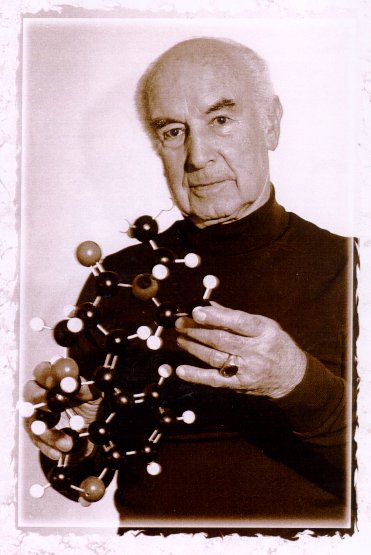
The New York Times obituary; the BBC report (with a classic photograph); and the Albert Hofmann Foundation.
I often think of Albert Hofmann's first deliberate trip -- on a bicycle, riding home from his laboratory.
update My father pointed out Albert Hofmann's speech at his hundredth birthday celebration, and some comments on the speech Hofmann gave.
In praise of the cooky
I appreciate the cooky as a unit of measure, as a mathematical proof, but mostly as a chocolate-laden treat.
April 29, 2008
In which we honor Mariah Carey; Or, lies, damn lies, and number-one singles
A few nights ago, the Empire State Building was lit in honor of the singer (and, lest we forget, actress!) Mariah Carey.

With her new album (E=MC2) and its first single, she now stands second only to The Beatles for number-one singles on the Billboard Chart. (Does her new album count as "math rock"?)
I like Mariah Carey: her voice, her songs, and how criticism about her enriches my vocabulary. I wonder how she ends up driving the music industry and having the lights on the Empire State Building honor her; why not Thurston Moore?
April 28, 2008
cenotaph
Cenotaph was a word familiar to me from name-play in Asterix and the Normans, in which the Gauls seek out the meaning of fear. I have yet to use it in a sentence, however; I could say, "What is the way to The Cenotaph" if I were looking for the memorial in London which has all sorts of curious geometry; I could more usefully ask, "Is this a cenotaph or a tomb?" when looking at a memorial; or I could wonder about the word's origin (literally from the Greek κενοτάϕιον, κενοϲ "empty" + ταφοϲ "tomb"). Or I could consult Wikipedia for a list of cenotaphs around the world.
April 21, 2008
In which we valet-park, with robots
From JapanProbe: "Customers who come to the station by bicycle need only place their bike on a small platform and hit a few buttons, and the system will automatically store their bike in an underground parking garage that can accommodate 9,400 bikes. When the reporter asks the machine to retrieve his bicycle, it only takes 23 seconds to accomplish the task. The parking system costs 100 yen for a single use, or 1,800 yen for a monthly pass."
More video at the JapanProbe site.
San Francisco's own master bicycle valet parker kash runs the Warm Planet bicycle shop at the Caltrain station in San Francisco [PDF].
April 20, 2008
In we doff our hat
Seeing Adam Albright's name at the top of the new Language Log brought a smile to my face.
The Language Log, long a favorite of both esoteric and popular linguistics, brings together academic writers on a delightful variety of topics. It also introduces me to other language-related blogs, including Mr Verb.
April 19, 2008
Crazy
Since seeing Bryan Louie's video for Gnarls Barkley's Crazy in an exhibition about innovative electronic media, I cannot get the song ("Best Song of 2006!") out of my head (where have I been?). The band's televised performance of this same song is equally hypnotic.
Why do large insects and bug-spray invariably call to mind my friend Wm. S. Burroughs?
April 18, 2008
A few words on the aroma of death
There ain't nothin' more powerful than the odor of mendacity...You can smell it. It smells like death.— Tennessee Williams, Cat on A Hot Tin Roof
CASSANDRA This house . . . It’s horrific!CHORUS
Why call out in horror? Is there some vision
in your mind?CASSANDRA
It's this house—
it stinks of murder, blood slaughter . . .CHORUS LEADER
No, no—that's the smell of sacrifice,
victims at the hearth.CASSANDRA
That smell . . .
it's like an open grave . . .CHORUS
Do you mean the splendid Syrian incense?
It's all through the house.CASSANDRA [turning back to the palace doors]
No. But I must go.
I'll lament my death, and Agamemnon's, too,
inside the house. Enough of living!— Aeschylus, Agamemnon
The powerful refrain of Mendacity! rings through the film adaptation Tennessee Williams's intense play, but for years I have conflated mendacity and complacency; only after breaking down the words did I better separate their usage. I think I have even gotten a few odd looks when using mendacity during conversation.
The section of Agamemnon has some stunning imagery in the original, with the vocabulary of sacrifice suddenly presented in the context of drama. I wanted to write a paper around this, but my knowledge of Greek vocabulary was never strong enough; I have been reading the Agamemnon from a copy available online, but without my annotated copy of Liddell and Scott (available online, but .... not quite the same) and lacking the unequalled references of Smythe's Greek Grammar and Denniston's Greek Particles, I am adrift. That Denniston edited the Oxford University Press text of the Agamemnon is not coincidence: the work is notorious for its complexity and sophisticated use of Attic Greek.
April 17, 2008
In which my eyes are plate-wide
Aram brought to mine attention this month-old post on Craigslist (San Francisco, for reasons that will become quite clear): http://www.craigslist.org/about/best/sfo/608546617.html.
Craigslist has collected it under the "Best-of", which is a user-driven distinction. This post is a splendid successor to Theodocious Ferocious's "One Less Fixie" post of a few years ago, which commemorated the brief popularity of freewheeling front-brake-only pista bicycles and their numbskull riders.
"my eyes are usually plate-wide with terror"
April 16, 2008
A few maps
While tidying up my desk, I found the following maps:
Manhattan & Welsh Guide to New York City (a search on Google for this term does not yield promising results!), which I picked up at the Mid-Manhattan Library a few days ago before a multi-lingual poetry hoe-down;
NYC Cycling Map, 2007 edition. The 2008 map is now available online: http://www.nyc.gov/html/dot/downloads/pdf/bikemapfront2008.pdf
http://www.nyc.gov/html/dot/downloads/pdf/bikemapback2008.pdf, which really should be in my cycling bag;
Andorra (Andorra? Andorra!), which an eager Andorran pressed on me in Brussels;
and Biblical Sites in Turkey (at atlas with gazetteer, actually) recently sent me by my parents. Some appealing photographs complementing this book appear in the Biblical sites in Turkey flickr pool.
April 15, 2008
A few words on growing up Scots
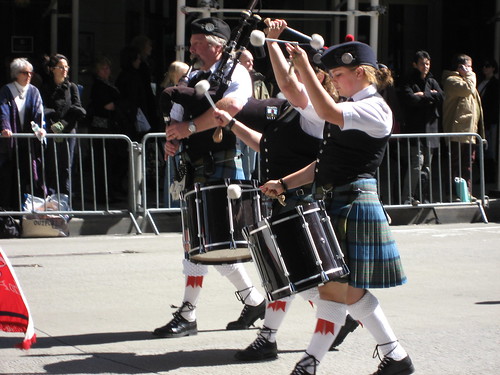
In my younger years, I often fell asleep hearing pipers practicing on a nearby hill, and a subliminal message has since compelled me to avoid wearing pants -- although I missed last week's Wear a Kilt To Work Day, part of the Tartan Week festivities. Some words on the historical importance of the kilt (and of whisky), from The Glenlivet's advertising posters:
The Glenlivet and the kilt share more than just Scottish origins – both were once against the law! Under England’s King George IV, the 1746 Dress Act banned all items of Highland dress. The same monarch imposed excise laws banning all production of whisky in 1781. Despite this, when King George IV visited Scotland in 1822, he himself insisted he would drink no other whisky than the “illegal” The Glenlivet. On this same trip, the king and his retinue also donned tartan outfits, reinstating both Scotch whisky and the tartan in the same visit.Kilt is a Scottish word that means “to tuck up the clothes around the body.” The word derives from the Old Norse kjilt, which means “pleated.” A 1746 description of the versatile garment states: “The garb is certainly very loose, and fits men inured to it to go through great fatigues, to make very quick marches, to bear out against the inclemency of the weather, to wade through rivers and shelter in huts, woods and rocks upon occasion; which men dressed in the low country garb could not possibly endure.” Today, the kilt is generally regarded as formal dress and can be seen at wedding and black tie occasions.
The mutual vocabulary of Scots and Swedish intrigues me: words such as bairn and the comparable formations of sijkhus stand out. Through reading about the history of Scots, I came upon the European Bureau for Lesser-Used Languages, which promotes languages and linguistic diversity.
April 14, 2008
Is it not art? We are artists!
Consider Levi van Veluw; consider The Enigma. Art? performance? photograph? Does a specific application of technology equal art? Does art require the skillful and expressive match of technique to technology?
Pete Goldlust's carved crayon series may be the result of advanced industrial automation, but the skill, vision, and execution are artistic.
Finally, keeping it old-school: this morning's New York Times reported on Leonardo's having illustrated a chess book:
The book, “De Ludo Scachorum,” or “The Game of Chess,” is by Luca Pacioli, a Franciscan friar and Renaissance mathematician who was a friend and collaborator of Leonardo. One of the earliest chess books, it contains 114 diagrams of chess problems drawn in red and black.Long thought to be lost or destroyed, it was discovered in 2006 in a 22,000-volume library in northeastern Italy that belonged to Count Guglielmo Coronini, who died in 1990.
The last part amuses me greatly: the book was long thought lost. With the instantaneous (well, hundredths-of-a-second) speed of information retrieval, the thought of something being lost in a library charms me.
April 13, 2008
Gansevoort and Little W. 12th Street
The name Little W. 12th Street has stuck in my mind as both quaint and appealing. No longer: the city has undertaken to insult the cobbles of adjacent Gansevoort with heavy concrete blocks and odd bollards, (lest you think that the latter are reminiscent of chocolate truffles, the whole ensemble brings to mind East German public space circa 1976, in a particularly grey and dreary rainfall).
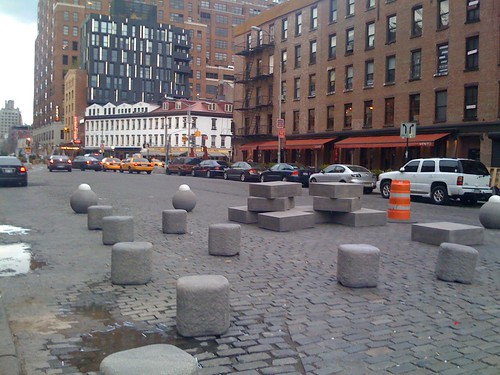
I have no idea what the city expects to accomplish: the heavy blocks will indeed prevent traffic from passing through and coerce speeding limousines into a meek line, but the overall effect is the opposite of what this pleasant space deserves. With the mixture of mid-rise hotel and several low-rise brick ateliers (n�e warehouses), some sort of low cement pedestal and brightly-coloured sculpture would fit, or a small plaza with a few honey locust or flowering dogwood trees.
April 12, 2008
MADison and 56th
The unusual engraving on the surface of Michael Heizer's Levitated Mass show the location of the piece: 590 MADison Avenue.
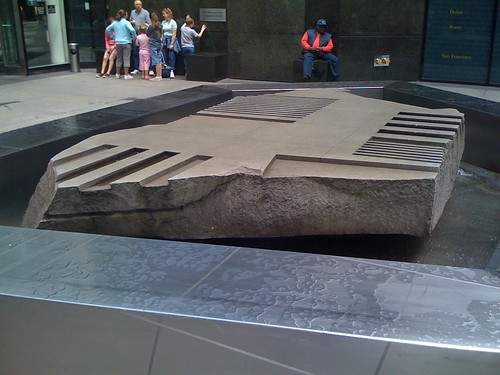
A-propos: within minutes of my having posted these photographs on flickr, web search through Google had indexed them (well, the text at least). The complete set is available; I took them in part because I have not been able to uncover good, publicly-available photographs of this sculpture.
April 11, 2008
Donnell Library Center
An encomium of the Donnell Library Center, which is closing to make way for a luxury hotel-condo building; a picture, a thousand words:
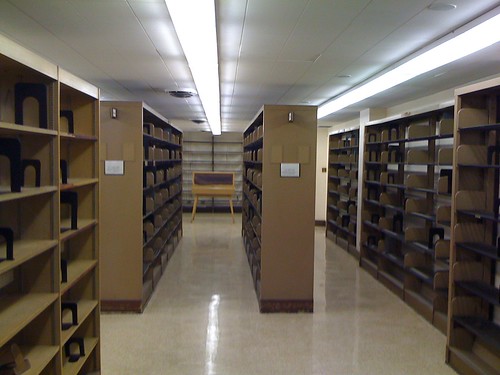
Seeing these empty shelves stunned me; even though I knew the library was closing, I did not count on having my muscle memory (here is Calvino; here is Wodehouse; here, sometimes, are copies of Murder Must Advertise) thrown off completely. The empty shelves brought home the imminent closing of the library, and I wound up trudging to the Young Adult section upstairs to find a book. Some (adult) fiction remains on shelves adjacent the science and history sections, but most of the collection is headed to storage in anticipation for the summer-time closing of this library.
A few words on riding the subway / bibelot
Often, when riding a crowded subway car in the morning, I will necessarily stare at the advertising placards, reading in each medical condition for which a cure is on offer (bunions! hammer-toe! skin blemishes! weight loss! weight gain!) and the social ills I might solve with a phone call: bankruptcy, a divorce, an injured child; the pleasures I will gain from cologne, whiskey, candy, patent medication. I stare at the ads to avoid staring at the newspapers around me, which I have learned is not done (in fact, I learned this from a whisky ad on the subway and then confirmed it with Anna). Sometimes I bring my own book, but more often I stare at the ads. On occasion, music from someone's headphones will bleed out into the subway and a tune will stick in my head.
This morning, the word bibelot popped into my head, and I couldn't get it out: where does it come from? (Latin, through French) How might I use it? (in lieu of bauble, chachka, geegaw, gimcrack, knickknack, trinket, or whatnot; the latter is a special favourite of mine).
April 10, 2008
Much Obliged, Jeeves
One of P G Wodehouse's most outstanding efforts, replete with: the country house; the village intrigue (in this case, an election); the newly-rich; the thieving butler; the do-good putative fianc�e; the haughty millionaire; and a napping cat. I hugely enjoyed reading Much Obliged, Jeeves.
April 9, 2008
In which pretty girls don't ride the subway
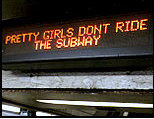
MTA Service Specialists have taken to the rails; never mind that straphangers will be shouldering the costs of Albany's rejection of the congestion plan, this is a certain way to improve subway ridership and have riders enjoy the trip.
The State Legislature's surprising decision to table the New York City congestion-pricing proposal still staggers me. Not only would does proposal address congestion within Manhattan, it tackles the critical issues of transportation funding and infrastructure. The Legislature's action smacks of provincialism. Streetsblog has excellent coverage of the congestion-pricing issue.
The New York Times had an enjoyable article on the new Hudson tunnels for New Jersey transit, a great feature discussing the urban communities around street design in "Taking Back The Streets", and a vehement editorial on equitable tolls for highways.
Everyone rides the subway: day or night, express or local, whenever I board a subway train the cars are full of people. The streets too are chock-full of cars, trucks, and buses; something must give, and sooner rather than later we must address both the cost and the financing of transit in New York City. The pillbox-hat-wearing stewardesses underscore the lack of service on the MTA: after exchanging a fare hike for service improvements, the agency reneged on the promise and left riders with the increase in fares but without a commensurate increase in service.
Sounds familiar, from what the San Francisco MUNI pulled in successive years.
April 8, 2008
Serendipities
I read and enjoyed Umberto Eco's slim volume Serendipities, a collection of lectures edited for publication.
The power of falsity focuses on the legend of Prester John and the impressive force of verisimilitude (a concept that hearkens to my high-school Spanish lessons, reading Borges in Señora Schmerz's classroom).
Languages in paradise: what was the primordial language, the tongue used in the Garden of Eden? In addition to the cabalistic obsession with discovering this, wild theories abound since the days of the Greeks. Eco pays special attention to an essay by Dante Aligheri. The essay predates the Paradiso by a decade and presents a different
Dorothy L. Sayers died thirteen cantos short of completing the translation of Dante's Divine Comedy; Dante himself died before publishing these same thirteen cantos, andd only after his death did his sons discover and publish them. Or so goes the legend retold by Eco; I can never decide whether he quotes the truth, or even a well-told but unsubstantiated rumour. At one point in his second lecture he goes so far as to quote from an unpublished paper which quotes a manuscript attributed to Abulafia, and this particular attribution made me wonder whether his examination of language was real, or an exercise in fiction.
The book has the subtitle Language and Lunacy.
April 7, 2008
In which we are stuck in these maps and legends
The New York Times describes restoration of a acres-large terrazzo map in the Tent of Tomorrow, part of the fabled World Fair of 1964-1965.
Just what you would do with such a map — other than admire it — is unclear. Even after conservation, it would be too fragile and uneven to serve as a walking surface, much less a driving surface. (One World’s Fair-era photo shows a girl at the wheel of a toy car tooling down Route 83 out of Fredonia.) And it will almost certainly never again be used as a concert venue, as it was in the late 1960s, or as a skating rink, as it was in the early 1970s, when the terrazzo was covered with a layer of polyurethane.
This feels like an episode from a story by Jorge Luis Borges, in which an imagined world is laid out as part of a funfair; eventually Scharlach the Dandy runs his well-meaning quarry to ground, explaining that the hapless academic was drawn in by the promise of an antique manuscript, clues to which were found only in the map. The manuscript does not exist; the map was made for a promotion with a children's breakfast-cereal company; and the academic was the last witness in a case against the Dandy.
April 6, 2008
Low Life / desuetude
"The Bowery itself had fallen into desuetude."
desuetude: "disuse," from desuetus, pp. of desuescere "become unaccustomed to,".
Re-reading Luc Sante's Low Life, an account of New York's nineteenth-century underbelly, has proven a mixed bag. I enjoy the anecdotes and historical tit-bits about ragamuffins, pick-pockets, houses of ill repute, and political antics; but I yearn for more, and perhaps even a highly-illustrated reference to the dissolute Manhattan of yesteryear. An edition replete with maps, historical documents, and larger prints of the photographs Sante already includes would be splendid.
In conjunction with my perpetual reading of Burrows's and Wallace's Gotham and of The Power Broker, Robert Caro's monumental biography of Robert Moses (the latter links to his typsecript comments, from The Bridge and Tunnel Club web site), books such as Low Life provide a more digestible, or at least more portable, account of Gotham's yesteryear.
April 5, 2008
In which we find the penny dreadful
Every few weeks, I haul the pocket-sized sack of coins that I have accumulated to the store around the corner; there I exchange them for a certificate I can redeem at a favorite online merchant. Many of the coins are pennies, but some of the sackful includes nickels, dimes, and quarters; half-dollars rarely circulate (and, I imagine, annoy cashiers at least as much as the Sacagawea dollars and Jefferson twos I cheerfully use to pay).

The United States' approach to coin and paper strikes me as woefully sentimental. David Owens's penny piece in the New Yorker touches on points historical, technical, and social. It's great, including the misquotation (eggcorn?) of "hordes" for "hoards". I appropriated the new Jefferson nickel as an illustration, rather than the similarly expensive penny, because it is a truly impressive piece of engraving.
April 4, 2008
A few more whacks on this dead horse
SFist has a nice roundup of recent Translink developments. I complained that the Translink developers were new to the transit world, only to hear that the Cubic Corporation, developers of New York's MetroCard
What is the importance of automated fare collection? and now of "touchless" fare collection? The accounting needed to manage fare collection, especially
http://www.gothamgazette.com/article/transportation/20060213/16/1758
In which we see the b of the bang
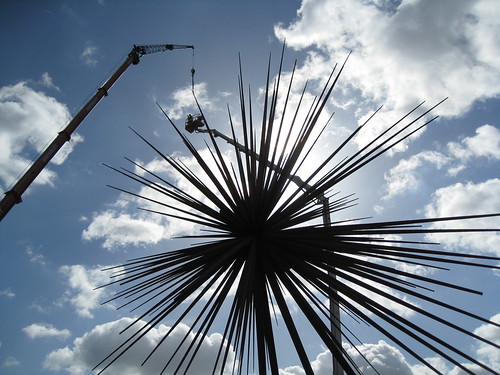
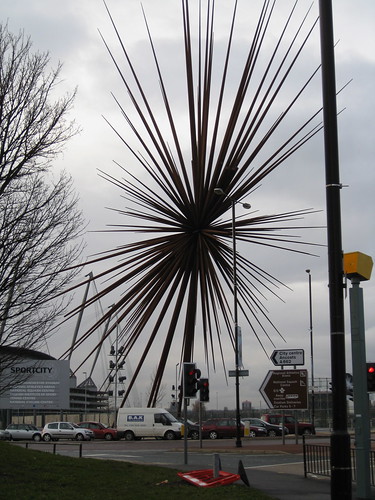
The genius of this sculpture outside the site of the 2002 Commonwealth Games comes from a quotation attributed to the British sprinter Linford Christie (who is eminently quotable, and apparently ready to rumble): I start running at the 'B' of the Bang from the starter's pistol.
Never mind that the whole thing is slowly falling apart, and even when I walked past I thought it was still under construction (it's not; it's under litigation).
April 3, 2008
In which we are in the taco bizz
This one goes out to the trumpet player on the Lexington Ave. line, whose unexpectedly jazzy version of this song caught me unawares mid-day. I had a big-hole single of this song which split, perhaps from overplay, rendering it forever unplayable. I taped it to the front of the shoe-box which held all of my seven-inch singles. Consider the above video vs this one (warning: animated content).
vs (This is a public-service announcement, with guitar)
vs
The former has amazing footage of a breathtaking band at its best; the latter is delightfully perverted. Neither is artful, but both make a point.
April 2, 2008
On the tribulations of language: words and punctuation
This fellow read the OED from soup to nuts (perhaps from alpha to omega?) and is now blogging about it; this fellow documents the inconsistent treatment accorded to the letter L in hand-written signs, and blogs about it (with photos!); me, I am fond of the grocer's apostrophe and puzzling punctuation.
... as are other people: Apostrophe Abuse illustrates the perils of modern-day puncuation; ritual observation of the importance of punctuation happens on National Punctuation Day; and the "emphatic" use of quotation marks in signs and signage.
And the most excellent writers of The Language Log share this gem:
Proofreaders rejoice! The missing apostrophe on the granite base of the new Ernie Banks statue is now in place. It took a stone carver about 30 minutes Wednesday morning to complete the work, said Lou Cella, the sculptor who made the statute. The missing punctuation was noticed when the statue was unveiled on opening day at Wrigley Field Monday.

later corrected to

April 1, 2008
nonplussed
I have been mis-using the word nonplussed for quite some time; like fey, inflammable, and unravelled it means the opposite of what I think it does (the latter two more so than fey, I suppose; I became overly excited about the denotations of fey one day in the eleventh grade, and eventually the teacher removed me from the classroom.)
Nonplussed means "surprised, perplexed to the point of speechlessness":
... The New York Times Manual of Style and Usage: “Nonplused does not mean fazed or unfazed. It means bewildered to the point of speechlessness.” To me, it does (more or less) mean ‘fazed’ but does not mean ‘unfazed’. Despite this confusion, perhaps The New York Times copyeditors should pay more attention to the basically sound advice in their usage book. The fact that this book takes on the topic shows that the meaning of nonplussed has indeed become an issue; the previous edition did not have an entry for this word ... "
vs (slack and tight)
vs
shout out to Aden and to Mark Athitakis, and to the Hillel House concert where the former played this song with the name of the latter cleverly substituted into the chorus. I never especially enjoyed Superchunk, but the familiar name made the melody so much more appealing. Now, these fifteen years later, I find myself humming the refrain at all sorts of odd places (killing time on trains, for one).