May 30, 2008
The view along 28.9º offset
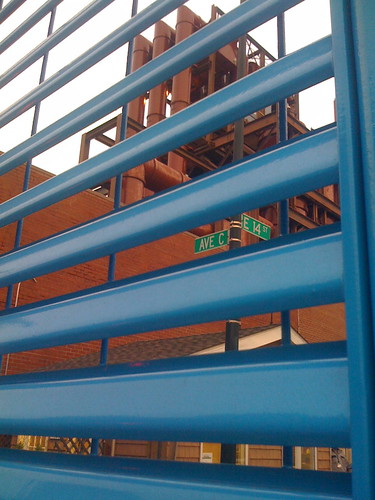
This should have been a perspective of the setting sun, the disc revealed in its entirety, but clouds moved in late afternoon and spoiled an otherwise spectacularly sunny day. The phenomenon of Manhattanhenge occurs a few times each other, but none as spectacularly as in late May. The term comes from an article in Natural History magazine by the astronomer Neil DeGrasse Tyson.
May 19, 2008
In which we make all languages one
Google's new translation tool has more languages and more shine. This tool has helped me read through innumerable web pages in the past. Although it does not answer all questions about internet sites in other languages, it provides excellent tools for reference-checking and for aiding me in understanding foreign-language posts.
The new languages include Bulgarian and Greek (although not Attic, or classic, Greek; I am encouraging Google to apply statistical machine-translation methods to the corpus of Greek, Latin, and Sanskrit literature), as well as improvements to the existing languages' translation facilities.
I didn't say babel fish, nor babelfish. Nor 72 views of the tower of babel (I have been waiting for a while to incorporate that into something. Now is the opportunity!).
May 17, 2008
May 16, 2008
Dogfish Head Burton Baton
The Burton Baton is the first beer from Dogfish Head that I have enjoyed quite so deeply, and possibly also the first IPA I have enjoyed in years. The heaviness of the beer offset the sparkle of the IPA, and overall it was a joy to drink.
In which we see the past in pictures
I am perplexed and fascinated, not necessarily in that order, by Reportet the "gallery of reconstructed portraits". The gallery includes Herodotus and Vercingetorix, about whose physical characteristics I have never really been curious. Attila, however, does stir one's curiosity, as does Charlemagne, short and fat.
May 15, 2008
May 14, 2008
Old Chub

Robert Rauschenberg

The New York Times's obituary has a good summary of Robert Rauschenberg's career and influences. Mr Rauschenberg died on Tuesday.
May 12, 2008
In which more is more
Andrew Bird wrote a piece about recording songs for his new album. Part of the New York Times's Measure for Measure blog, it has insight and humour and beauty. I love reading about the minutiæ of recording, especially about the contemporary music I really enjoy. Seeing large tape machines rolling, thinking about sliders and pots and mics and speakers and amplifiers, it's all quite exciting. Thanks, Aram, ever keen to the intricate technology of sound recording, for pointing this out.
May 9, 2008
shoddy
Shoddy entered our language as a noun, mid-nineteenth century; it denoted a garment made from recycled or already-used wool, and shortly afterwards became an adjective describing anything shabby or inferior (it has an interesting secondary meaning, "pretentious vulgarity": showy).
Where it came from, I know not; nor does Etymology Online.
May 8, 2008
In which I look at photographs
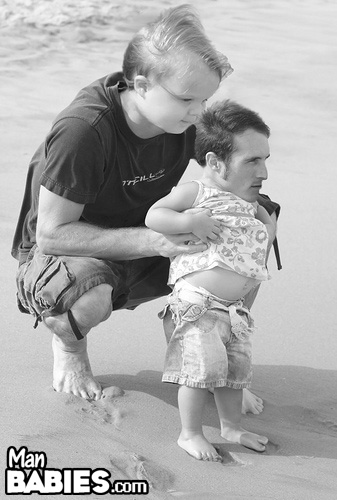
In looking over photographs on the internet, the short attention span in me enjoys many of the amusingly-captioned contributed-photography sites. LOLCats, of course; and also Man Babies, photobombing (not photobombing). Of course, plenty of stuff on flickr: sticker art, smashed cars, bicycle parking: something for everyone, especially for me.
May 7, 2008
In which I found that essence rare(r)
Aram pointed out, via the excellent Brooklyn Vegan, that stalwart Gang of Four rockers Dave Allen and Hugo Burnham are leaving the band (again).
Did I write stalwart? I meant totally awesome. I could hope to fit all of that cool and kickass into my whole lifetime — they stuck it into each of their records. I got a copy of their first record from a girl at my high school who was moving to California (to attend Berkeley, if I remember correctly); I was a couple of years younger than she, and received a stack of her hand-me-down records (Psychic TV amongst them) when she cleaned house. I was not prepared for what came over the speakers when I first put the needle down: the rhythm! the energy! the anger! Give me punk rock! Give me funk!
The first video is from The Old Grey Whistle Test television programme twenty-five years ago, the second from the Electric Picnic festival recently.
May 6, 2008
In which we warm to the new theories
The New York Times ran an excellent and exciting story about research at Lake Baikal. The story excited me for many reasons: a family has, from one generation to the next, steadily collected data about the water and the ecology of the lake.
Every week to 10 days, by boat in summer and over the ice in winter, he crossed the lake to a spot about a mile and a half from Bolshie Koty, a small village in the piney woods on Baikal’s northwest shore. There, Dr. Kozhov, a professor at Irkutsk State University, would record water temperature and clarity and track the plant and animal plankton species as deep as 2,400 feet.Soon his daughter Olga M. Kozhova began assisting him and, eventually her daughter, Lyubov Izmesteva, joined the project. They kept at it over the years, producing an extraordinary record of the lake and its health.
Now Dr. Izmesteva and scientists in the United States have analyzed the data and concluded, to their surprise, that the water in Lake Baikal is rapidly warming. As a result, its highly unusual food web is reorganizing, as warmer water species of plankton become more prevalent. These shifts at the bottom of the food web could have important implications for all of the creatures that live in the lake, they say.
Although Dr. Kozhov is famous among scientists who study lakes — his 1961 book “Lake Baikal and Its Life” is considered a classic — the new report is “the international debut of the Kozhov family’s legacy of research,” Stephanie E. Hampton of the National Center for Ecological Analysis and Synthesis at the University of California, Santa Barbara, said in an e-mail message.
Props to the New York Times for implementing a "Share" feature that provides an easy-to-use "permalink" to each of its articles. This is the paper of record, yearning to be free.
May 5, 2008
In which we see a clam in a jam

Emily Jo Cureton takes a few clues from each day's New York Times crossword puzzle and illustrates the resulting, sometimes fragmentary phrase. Favorites, though I needn't pick: bonsai egret, lets dropit, and ALIEN SOUSA.
May 4, 2008
May 1, 2008
Sir, or Don't call me darling
I get a shifty feeling when people call me "Sir". I admire honorifics and epithets, but none apply to me: I am neither lord nor baronet to anyone, nor am I their sire. I suspect that people calling me sir have a mild inferiority complex, or a misguided sense that they are being polite, or labor under the painful misapprehension that they need to defer to a client.
Just as on the venerable television news program "60 Minutes", which I watched assiduously as a young'un, I see a pattern. When someone being interviewed on that program started calling the reporter conducting the interview "sir", then they were hiding something. The "sir" was a verbal distraction, a sleight-of-tongue (as it were) that meant, "Oh, I'm entirely honest and without reproach".
I don't mind if someone calls me "boss" or "chief" as much, although those do have a slightly disparaging edge (perhaps I read The Catcher in the Rye too often?) I prefer that people call me by my name, and, if they do'n't know it, that they ask.
During a business transaction, the man on the other side of the handshake kept calling me "Sir", without irony or sarcasm or even a hint of inflection other than his northern New Jersey accent. I found myself wondering, Why? and after we parted company (deal intact) I was humming a song with the refrain "Don't call me darling".
Of course, this video is available from the YouTube. Bless the YouTube for its ability to fulfill the vision that Eyebeam had two decades ago: FTv, or Filler TV. This channel gives you endless two- and three-minute pieces of programming designed to fit into the awkward gaps between other programs, before leaving the apartment, perhaps even between courses. Filler TV! The Fall!! Don't Call Me Darling!!