June 24, 2008
Ayveq
Ayveq died yesterday (this last story uses a photograph of mine as the illustration).
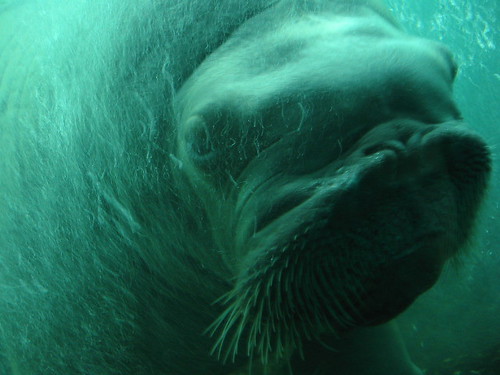
Ayveq the Walrus
Photographs of Ayveq, which, curiously, I have never uploaded to flickr.
June 23, 2008
Harry J. Aleo
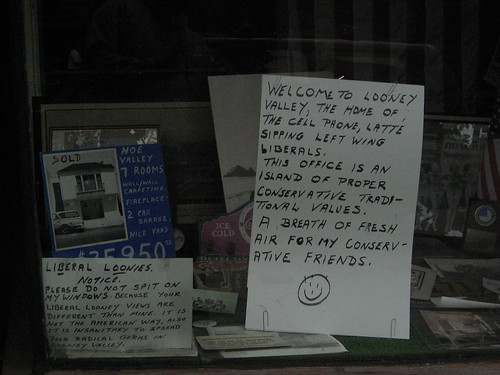
Harry J. Aleo, the colorful and plain-spoken horse-racer, real-estate dealer, and baseball player (baseball player!), died over the weekend. Although I knew him from the signs in his 24th–Street storefront, he had led, by all accounts, a rich and sincere life.
I will never recover from that first shock of seeing a Reagan poster in Noe Valley.
June 22, 2008
More on spending lottery winnings
One of the aspects of New York City's streets that has me shaking my head: the prevalence of half-stolen bicycles. Almost every block has a utility pole or parking meter with a scavenged bicycle stuck to it; I thought that, should I win sacks full of money by playing the lottery (which I don't), I would cycle around town fixing these bicycles and redistributing them. This idea now strikes me as naïve and optimistic: a more constructive approach would be to repair everyone's bicycle, for free, with priority to people who use the bicycle for everyday work (deliveries, commuting, et c.). Roadies and recreational riders probably don't want me wrenching on their bicycles, anyhow (me, tired after fixing on bikes).
I began taking photographs of these, which I call Unhappy Bicycles. See the slideshow of this neglected and picked-apart bicycles of Manhattan.
June 20, 2008
In which you can never have enough hate
Hatred for stroller-pushing latte-sipping line-cutting moms in Brooklyn bike shops; hatred for the disappearing, long-forgotten past; and hatred for things in general, dammit. Warning: Some links more bilious than others.
June 19, 2008
prurient
Sometimes I find that a word in a completely ordinary context leaps away from the page and stands out. When reading Alberto Manguel's editorial piece on libraries — on his personal libraries — in The New York Times, prurient leaped out at me. From Sanskrit through Latin, it denotes something "marked by or arousing an immoderate or unwholesome interest or desire". It has as its immediate root the Latin word "to itch" as in "to crave": prurire, which the Online Etymology Dictionary suggests has a shade of "to be wanton". The Sanskrit root means "to singe", which conjures up all sorts of Roman poetry.
Alberto Manguel is a fabulous author and a writer of breathtaking skills.
June 18, 2008
In which Los Angeles drops the ball
The Los Angeles Department of Water and Power has been dropping bird balls into the Ivanhoe Reservoir in order to control the creation of carcinogens within the water. The LA Times reported that "The water needs to be shaded because when sunlight mixes with the bromide and chlorine in Ivanhoe's water, the carcinogen bromate forms, said Pankaj Parekh, DWP's director for water quality compliance. Bromide is naturally present in groundwater and chlorine is used to kill bacteria, he said, but sunlight is the final ingredient in the potentially harmful mix. The DWP drop was designed to stop the three from mingling in the 10-acre, 58-million-gallon Ivanhoe Reservoir. The 102-year-old facility serves about 600,000 customers downtown and in South Los Angeles." Donna Barstow's blog has a different, well-informed take, describing possible risks to human health from the degradation of the plastic balls; the risk to avian life from the sudden inaccessibility of the water; and the overall inutility of the balls, considering the water flow through the Ivanhoe and Silver Lake reservoirs.
In which we have no bananas
Dan Koeppel, author of the outstanding history Banana, has an editorial piece in today's New York Times. He suggests that the rising price of fuel and the ongoing floods in Ecuador will combine to produce $1/lb. bananas, a significant price threshold for this ubiquitous food. He discussed the factors that have kept banana prices low, and the monoculture that makes the contemporary consumer banana extremely vulnerable to blight, and draws the conclusion that we ought to look for a different fruit to enjoy on our bicycle rides.
His book (full title: Banana: The Fate of the Fruit That Changed the World) does not directly answer a question that pops into my mind almost every day: why do bananas from the street vendors always cost a quarter? His methodical research and vivid writing have brought me a more clear understanding of the supply chain and shenanigans of getting a banana to the cart. Last week I tried a short red banana, a different variety from the standard Cavendish, and found it surprisingly difficult to eat. After having eaten at least a banana a day for decades, I am completely accustomed to the specific taste and texture of a particular banana; this Red Banana (PLU 4236) took me by surprise.
The editorial is a reprise of themes from his book, written with a more moral tone than the book itself.
… the Cavendish is the only banana we see in our markets. It is the only kind that is shipped and eaten everywhere from Beijing to Berlin, Moscow to Minneapolis.By sticking to this single variety, the banana industry ensures that all the bananas in a shipment ripen at the same rate, creating huge economies of scale. The Cavendish is the fruit equivalent of a fast-food hamburger: efficient to produce, uniform in quality and universally affordable. …
In recent years, American consumers have begun seeing the benefits — to health, to the economy and to the environment — of buying foods that are grown close to our homes. Getting used to life without bananas will take some adjustment. What other fruit can you slice onto your breakfast cereal?
But bananas have always been an emblem of a long-distance food chain. Perhaps it’s time we recognize bananas for what they are: an exotic fruit that, some day soon, may slip beyond our reach.
June 17, 2008
Oddly, the law won
From Wikipedia:
Just after "I Fought The Law" became a top ten hit, Bobby Fuller was found dead in a parked automobile near his Los Angeles home. The police considered the death an apparent suicide, however many people still believe Fuller was murdered. The investigation was botched from the start. The scene was not taped off and no fingerprints were taken from the scene. A witness also had clamied seeing a Police Officer throw a can of gasoline found at the scene into the trash.[1] Police later changed the cause of death to "Accident". He was found with multiple wounds all over his body and covered in gasoline leading many to speculate that the perpetrators fled before they could set the car on fire. He is buried in the Forest Lawn Memorial Park (Hollywood Hills) in Los Angeles. Dead at age 23, Fuller barely outlived his idol, Holly, who died at 22.
June 16, 2008
In which we chuckle at the ordinary
Like Emily Jo Cureton's daily crossword-inspired sketches, Steven Frank draws inspiration from the electronic everyday. His muse: SPAM Subject: lines. Some favourites: thank snoop, Bug Message, and like flipping a switch that will allow you to get exactly what you want. Poorly-drawn cartoons inspired by actual spam subject lines!
June 15, 2008
In fabulo scriblitam propriam
While reading through the NYC Donut Report!!, I found further evidence that the rumour of a below-ground Krispy Kreme outpost may hold truth. On National Donut Day (the first Friday in June), they gave away donuts to all comers. I need to draw in a deep breath and venture back into the bowels of Penn Station, so that I can treat myself to the yeasty sugary delight.
June 13, 2008
In which we stoppeth one of three

The Rime of the Ancient Mariner is a beautiful poem. Wordle, an online application that creates art from type and text, reminds me of the first java applet I wrote. (Yikes! I can't believe that is still taking up disk space!)
Out of Gas
Over three decades, Camilo José Vergara has photographed decaying gas stations. The New York Times published a slideshow of his photographs. Vergara photographs many aspects of decay and blight across America; the Chilean-born photographer received a MacArthur Fellowship in 2002.

June 12, 2008
Ys
While looking up the mythical town in France, Wikipedia's helpful disambiguation page pointed me in the direction of the yoctosecond, a unit of time representing one-quadrillionth of a second. Yocto is the smallest of the SI units, denoting a factor of 10−24. The yotta in yottasecond, with the same ys abbreviation, denotes a factor of 1024 and is the largest SI unit.
June 11, 2008
June 10, 2008
Tom Sachs vs. Tom Sachs
Although I have not seen Tom Sachs's massive bronzes at Lever House, I did walk through the Animals exhibition at Sperone Westwater.
The title of the exhibition might as easily have been Sounds, rather than Animals: the sounds of an absent cat, of tools on their racks, or deadened (or amplified) pianos, and especially of animals becoming extinct -- all these sounds played an important role in the pieces. The Waffle Bicycle broadcast the adhan, the Islamic call to prayer, from loudspeakers mounted to a massive modified bicycle. The bicycle has all of the necessary ingredients for making waffles, from the live chickens for producing the eggs to the refrigerated whipped cream for topping the end product.
I first encountered Tom Sachs's work in the infamous Barney's Nativity display, and more recently on the cover of Dana Thomas's Deluxe: How Luxury Lost Its Luster. I am still uncertain about my grasp on the intersection of consumer culture and art as Tom represents it, but I enjoy the very visceral presentation of his work in the gallery setting. Tom brings a lot of surprisingly frank and violent ideas to his outwardly-calm pieces, such as the wood block with King Heroin burned onto gold leaf.
June 9, 2008
June 8, 2008
In which the web is our foley
Instant Rimshot vs Sad Trombone. If only the iPhone supported Flash ... well, that can be fixed: I recorded these into .mp3 files and made them easily accessible for my own nefarious purposes.
June 7, 2008
In which we face the end of guano
“It would be an inglorious conclusion to something that has survived wars and man’s other follies,” Mr. de la Torre said. “But that is the scenario we are facing: the end of guano.”
An article in The New York Times discusses the precarious position of the guano-collecting industry off the Peruvian coast. I learned of guano from the Tintin adventure Prisoners of the Sun.
June 6, 2008
How many Luxemborgs is Wales?
Arf's Sensible Units web site elegantly converts one measurement — 181 cm, say, — into something less abstract: 1.3 Alaskan moose antler spans. 15 CDs side by side. A little less scientific (and more joyful: "Convert boring units to real objects as you type!" is its slogan) than the sensational Google Calculator, but no less useful. For the record: 1 Wales is 8.0 Luxemborgs.
Where goes the neighborhood
EV Grieve writes about an old New York magazine article lamenting the yuppification of the East Village -- the gritty neighbourhood party to labour riots, to burned-out crack houses, to endless attempts at urbanization and revitalization. Scans of the article are in the blog post:
http://sophiesbar.blogspot.com/2008/06/lower-east-side-there-goes-neighborhood.html.
How long will it take to get there (or here)? An Avenue C bar owner prognosticated five years in The New York Times: "C will keep its edginess for five more years," predicted Melvina Goren, a partner at Porch. That was two-and-a-half years ago; in a survey of places to drink beer of a Sunday afternoon, Aram and I found all of the contenders overrun with everyone (and thence retreated to the excellent Creative Time installation at the Governor's Island Ferry Building).