September 30, 2007
thumble-rigged
I came across the expression "thumble-rigged" in a twenty-five year old book on the New York City subway, but do not find any online references to the expression, nor any reasonable usage of thumble itself. The context of the phrase suggested a meaning not along the lines of jerry-rigged or its predecessor, jury-rigged, but something more like "built by influence".
September 29, 2007
In which we hit the road
I have been meaning to keep notes (taster's comments? an inventory?) on the beer I have enjoyed this summer, but so far I have done very little along these lines. Aram sent this article about Maine beer. Road trip! (Better than the Dogfish Head idea I had a few months ago, perhaps.) I have happily found many tasty places to drink yummy beer this summer, and even a couple of places to get growlers — although I haven't, yet.
September 28, 2007
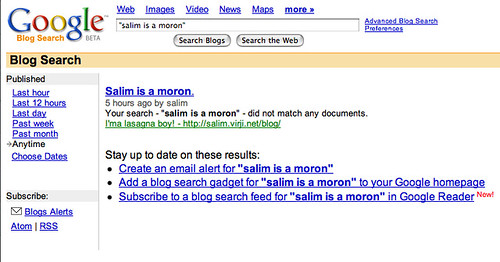
Salim is a moron.
Your search - "salim is a moron" - did not match any documents.
update A few hours later:
September 27, 2007
In which the borough welcomes a baby

My favourite walrus, Ayveq of the New York Aquarium, welcomed his new baby boy, one of a mere handful born in captivity . Lots of photos online.
September 26, 2007
síbín
A blind pig or blind tiger, a speakeasy by another name.
September 25, 2007
In which we read a long ass-bug
The blog of Randall Munroe, author of the unpronounceable xkcd, pointed me in the direction of the most amusing Mozilla bug report I have read in a long time, about the "Long tooltips should wrap instead of being cropped" issue.
September 24, 2007
In which you are what you eat
After a weekend thinking about Nabokov (thinking, mind you, not reading), seeing this blog posting about menus and anagrams made me quite cheery.
September 23, 2007
shiv, part III
Another candidate for the etymology of "shiv": chiv, Geordie slang for 'knife'. The Random House Unabridged of 2006 cites this as an American synonym dating to the 1850s.
September 22, 2007
Joe Chiodo
Joe Chiodo died a few weeks ago. A memorial video is on the YouTube:
I won (and lost! and won again!) a fortune on the lovingly-worn shuffleboard table at Chiodo's, the tavern at the foot of the Homestead High-Level Bridge.
September 21, 2007
In which we colon wonder
Why bother studying robotics? So that you can get arrested by the hair-trigger patrols at Logan? Arrested, or almost shot? Star Simpson, the MIT student in question, wore a home-made art-robotics project to Logan and wound up in pokey.
All three of the above news stories are essentially the same: there's no new news. In case you forgot, Boston over-reacted earlier this year, too.
September 20, 2007
At other times
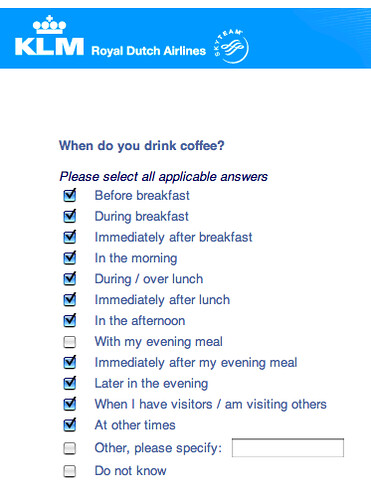
KLM figured out that I am the one drinking all the coffee on those long flights and sent me a survey, screenshot above. I'm not quite sure how to address the distinction between the penultimate and antepenultimate options, but I selected all the others. I do drink rather a lot of coffee. In fact, I'm drinking (Illy mild roast espresso, from a pod. Sigh!) a double ristretto (21 seconds per extraction) right now.
September 19, 2007
In which we don't cheat
Not entirely about donuts, not entirely about economics, but I like Kottke's anecdote about the coffee-and-donut vendor who has the customers make their own change.
This reminded me of the anecdote in Freakonomics about the suburban D.C. bagel-delivery fellow, who found that customers really did leave the correct sum more than 95% of the time. Over the course of several years, he collected data while delivering bagels to office complexes; the lean years resulted in less honesty than the fat, but overall people paid what they owed.
I am surprised at the honesty (but not at the coffee-and-donut vendor's popularity: efficiency is important, especially in the United States, especially in New York).
September 18, 2007
In which we pass through security
The current installment of Opus says it well:

September 17, 2007
The Works: The Anatomy of a City
Kate Ascher of the New York City Economic Development Corporation has written the entirely fascinating and very useful The Works: The Anatomy of a City, which takes the components of a city — New York, in this case — and presents their relationship to each other and to the people of the city; and their role in the massive system that makes up a growing urban area. The transportation, from sidewalks to subways; the utility systems, answering the question "What happens when you turn the tap on a hot-water faucet?"; the bridges and tunnels, which bring vast quantities of New Jersey twentysomethings^W^W^W revenue to Manhattan; and the waterways, which figure into each and every one of the other systems.
The volume shows love of the topic: the author meticulously researched the writing, drawing on her professional experience, from projects working on various infrastructure pieces around New York City; the pages have
well-illustrated pieces peeling apart street layouts, intersections and traffic systems, and street signs. Each page has a useful design and layout with crisp schematics and judicious use of photographs. In many ways, the book resembles David Macaulay's masterful The Way Things Work, but with a wonderfully specific New York focus.
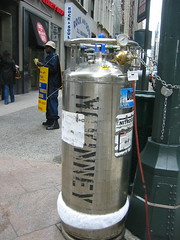
Ascher also has a sidebar explaining the mysterious nitrogen canisters I first noticed several years ago. These silver canisters, about five feet high, sit calmly at an intersection. A small hose connects to a manhole, and is fixed to the ground with gaffer tape. The canisters do not bear apparent indication of ownership, but, Ascher explains, are part of a three-hundred-strong fleet of canisters maintained by Verizon. They pump nitrogen into conduit in order to keep moisture away from fiber-optic lines; moisture attracts particulate matter that degrades optical signals and equipment. The nitrogen in each canister lasts about three days. What perplexes me is why this isn't done underground, with pumps and protected cylinders of the stuff; and why no-one (apparently) tampers with the aboveground nitrogen.
September 16, 2007
On obituaries
For many years, the New York Times's tradition of researching and publishing excellent obituaries has introduced me, if only upon the occasion of their death, to many riveting characters, to some quiet personalities, and given me the opportunity to reflect on some historically significant events.
Over the past few weeks, I have read with increasing dismay the story of Joe O’Donnell, “a longtime White House photographer” who supposedly took the iconic photograph of John, Jr saluting his father's coffin, and served in the now-defunct United States Information Agency. I have felt dismay at the story of his deception, and of his habit of casually taking credit for others' photographs — a habit that went undetected, partly because press agencies did not credit photographers by name in the 50s and 60s. Some of the dismay is at the dishonesty of the photographer, and some at the newspaper that published the obituary, a newspaper that has suffered through several troubling episodes of inaccuracy and outright fraud in its reporting these past few years.
The newspaper's Public Editor today published a thoughtful piece on the problem, noting specifically that the practice of interviewing close associates would have paid off in this story. This is the most interesting and significant piece that the office of the Public Editor, an ombudsman-type position that has been held by two prominent journalists, has yet produced.
Also in today's paper, a beautiful obituary of Eva Crane, whose scholarship and passion brought new science to the study of bees.
The problem with Wikipedia
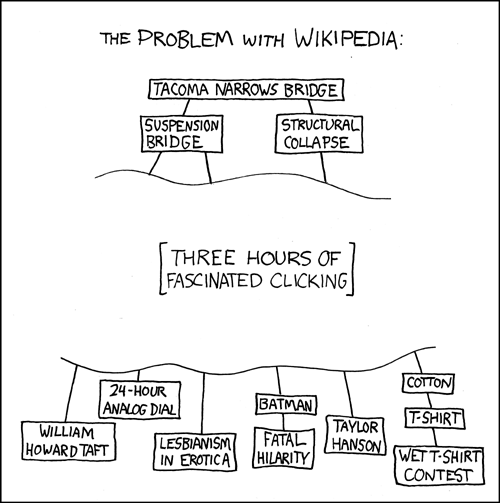
which explains how I started reading the cast list for Sidney Lumet's 1974 film Murder on the Orient Express and wound up staring at descriptions of the (first) Gulf War in one window and "Cultural references to Frank Zappa" in another: "A number of animals have been named after Zappa including a goby fish (Zappa confluentus[4]), a jellyfish (Phialella zappai[5]), an extinct mollusc (Amauratoma zappa) and a spider with an abdominal mark supposedly resembling Zappa's mustache (Pachygnatha zappa[6])."
September 15, 2007
In which the weird get stupid
Anna's right: this is a riveting story. The San Francisco Chronicle reports the latest plot developments in a story that began when Ross Mirkarimi of the San Francisco Board of Supervisors intervened during yet another drive-by shooting in his district. The drive-by shooting began with a wronged young man, who called reinforcements in the form of his parents; the parents arrive with a roaring engine and a car full of guns; they chase the son's assailant around Alamo Square, eventually running him to the ground and running him over. The assailant tries to commandeer a passing motorcycle, but the father rams the motorcycle, knocks down the fellow, and finally crashes his car and runs away.
Breathless stuff.
At some point the valiant Supe-r hero dives in and "reported what he saw to police and got into a patrol car to help them locate the suspects".

September 14, 2007
Discover Your Inner Economist
In his new book, Tyler Cowen, the author of the Marginal Revolution blog, discusses prizes versus incentives. These are two faces of a mechanism by which the (economic) world goes round: knowing when to apply them makes all the difference, however.
Much of the topical ground in this book resembles
Mr Cowen spoke informally at a brown-bag series today, and spent most of the time speaking about incentives versus grants. He used the X Prize Foundation's prizes for manned stratospheric flight and, more recently, unmanned lunar exploration as examples of how incentives can reward, if not spur, practical innovation. He also mentioned the DARPA Grand Challenge, which has so far failed to produce the desired result: a robot capable of navigating a course from Los Angeles to Las Vegas, and touched on the Netflix Prize to improve the DVD rental recommendations. For all of these, he mentioned the winner's curse: over-investment of resources such as time and money, at the expense of finding the correct solution. A counter-example that he did not mention is Dean Kamen's iBot mobility device (and predecessor to Ginger).
In comics: Hergé penned The Stratoship H.22, a two-part bandes dessines including Mr Pump's Legacy and Destination: New York. This adventure of Jo, Zette, et Jocko centred on a fabulous incentive ($10 million!) for achieving supersonic trans-atlantic flight.
Cowen's book did teach me one useful thing: to abandon enterprises in a short-circuit fashion. That is, don't sit through a boring movie. In this case, don't finish a dull book.
The Museum of Dr Moses
"The Museum of Dr. Moses" comprises a selection of dull and unexciting "tales of mystery and suspense", which dwell on the psychological but in a surprisingly unexciting way. Not a single one of the half-dozen (of ten in total) stories I read gripped me, neither for the storytelling nor for the story.
I have not read any of Joyce Carol Oates's other works, save perhaps the odd story in a magazine here or there; I think that I picked this up by mistake, having confused this author with another.
Adverbs
Daniel Handler's 2006 novel Adverbs presents several disjoint episodes in a rambling narrative about love.
Love, he proposes, is in the adverbs, not the nouns: barely, briefly, arguably his characters fall in and out of each other's lives, in and out of "different types of love". The writing is crisp at times, but the rambunctious nature of the plot and the too-similarly-named characters present a more modern view of the world than I enjoy. Handler drops seemingly-familiar names in each story, suggesting that they appear previously or subsequently; one or two times he breaks through the wall and states explicitly that the character is non-recurring, or should be familiar to the reader. I found myself spending an uncomfortable amount of time asking, "Is this the same Tomas from clearly? The same Andrea from immediately?
The motivation for this book might be in the physical nature of love: thus, adverbs; Handler brings us close to several physical encounters, but does not dwell on them. His characters tend to the sad and unfulfilled, even when in love — or in a relationship, at least — wanting more, wanting something else. Brief fantasies creep into each story, demonstrating that love is also about what isn't there and what cannot possibly be: fulfillment, redemption, magic, satisfaction.
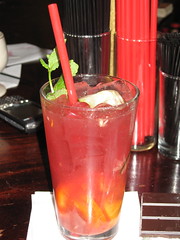
His characters also spend a lot of time drinking cocktails with fabulous names, including the Suffering Bastard, a Hong Kong Cobbler, and ad hoc creations such as a "mouthful of champagne followed by a sip of chianti". I first had the Suffering Bastard at a particular bar in San Francisco, a bar which in fact makes an appearance towards the end of the novel. The famously stylish and moody bartender there recently left, I hear, in a fit of pique about infused liquors (she made her own, and they are delicious and quirky).
September 13, 2007
Broadway and Bowling Green
The overlay in this map comes from the Castello Plan, a detailed drawing of New Amsterdam in the 1660s.
At a publisher's cocktail mixer several years ago, I proposed a large (very large!) format book that overlaid pre-Gold Rush maps of San Francisco with modern street plans, showing the infill and development along the waterfront. The internets make this easier.
HOWTO: Make an urban park in a parking space
The Rebar Group have a fun, illustrated write-up describing how to make a park out of parking. Got your Parking Day project all sussed out?
Here's a map, a call for volunteers, and an inspirational video (from San Francisco, last year).
September 12, 2007
On cycling in Amsterdam and San Francisco
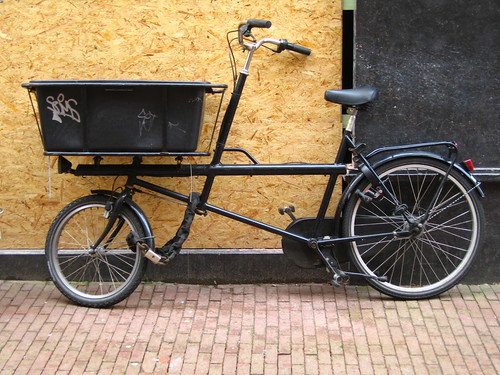
The perspective of a San Franciscan in Amsterdam, including reader-contributed photographs of kids, dogs, working bicycles, regents on cycles, and plenty more. I always take lots of snaps when in the Netherlands.
September 11, 2007
Good Reads
Sun Yung pointed me to Good Reads, which led to the following widget:

... which suggests yet another Flash-y thing-y to incorporate somewhere into this part of the site. I like it, but I don't know how much.
On the ham in our dictionary
Lexicographer extraordinaire Erin McKean discusses "serependipity" versus "searchability", the joy of the steampunk element in dictionaries, and how the English language is approximately the size of a ham.
In this brief talk she drops some delectable expressions: "charismatic megafauna", "ballpeen", and a comparison between mobile sculpture, traffic cops, and the language we use daily.
And, interestingly, she vets words: how does one determine that words are real, in the sense that they are valid. Being in the dictionary is an artificial distinction, she asserts; using and loving a word is what makes it real.
Link to talk: http://www.ted.com/talks/view/id/161. The embedded widget wasn't embedding.
September 10, 2007
In which we listen to the rails a-hummin'
The A train (née the Eighth Avenue Line) celebrates its 75 years with pomp and circumstance,
the 7, or the "International Express" extension may have platform doors (how will I search the railbed for rats?), and Amtrak ridership reaches a new high.
September 09, 2007
In which we see Nature in action
&t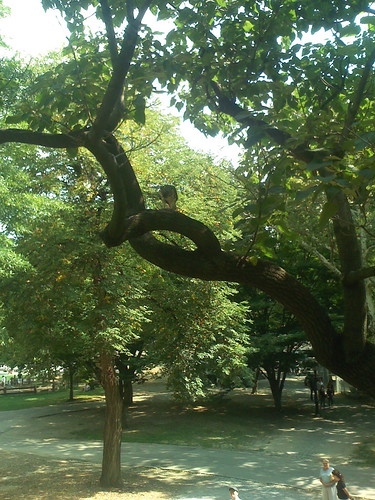
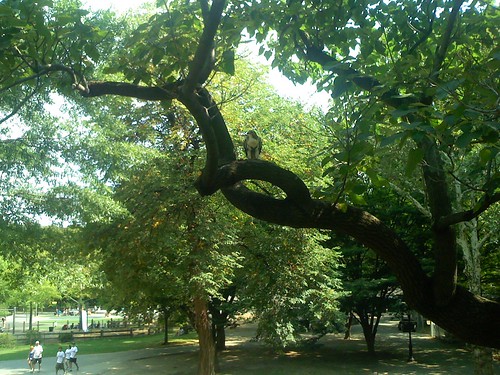
Central Park's famous red-tailed hawk, Pale Male, was dining about about the town. I pulled over as I was finishing a circuit of the Park, curious about why the throng of photographers was all agog. New Yorkers might identify with this raptor because he, too, had housing struggles.
The bird flew a few feet from my face after he swooped to catch a mouse; he alighted on a nearby bough and devoured it, and then neatly cleaned his beak and talons against the bark.
correction: A correspondent observed: "Just for the record, that's not Pale Male but the juvenile from the 888 7th Avenue nest." More photographs and narrative at his web site.
The Mystery of the Disappearing Inland Sea
The modern story of the Aral Sea is not a mystery: The Art of Mapping on the Run is the New York Times' perspective: 'In the new edition of “The Times Comprehensive Atlas of the World” (Times Books, London, 2007), for instance, there are before-and-after views of the Aral Sea, once the world’s fourth-largest lake. It shriveled as Soviet-era irrigation projects siphoned off the rivers that replenished it. A dam completed in 2005 now prevents water from flowing out of the lake’s northern lobe, which is expanding as a result.' The BBC perspective is less philosophical, and bluntly explains that the folly of human industry caused the changes to the sea.
Somewhere in a box we have a massive copy of the Times Atlas, probably from '04, and I wonder how the Aral looks in that one.
September 08, 2007
The Big Oyster
Once again, Mark Kurlansky has chosen an awesome topic and produced a mediocre book: see Salt and Cod. The Basque History of the World was an exception to this unfortunate outcome, in which his research and curiosity fall flat because of the writing. In The Big Oyster his prose again has many run-on sentences, mostly confusing compound constructions; the flow of the book is confounded by the intermittent, typographically-offset recipes he includes.
The history itself is fascinating: the humble oyster played a tremendous role in New York's economy and culture through the nineteenth century, and a pivotal role in understanding our effect on the New York Harbor through the twentieth.
The author presents riveting anecdotes and stories about Dutch, English, and American development in the city, all the while describing how Manhattan Island, Long Island Sound, and the Hudson estuary provided bountiful bivalves for us to eat in many preparations, build into roads and houses, and export to other nations.
As with other books that present a bygone and more sylvan portrait of America I felt nostalgic: I can't quite picture farms at 14th Street, or a trip to Turtle Bay taking a weekend from the Battery. I also have a hankering for oyster, and not just the tired sort one finds at the annual Oyster Festival (aside: I had some lovely photographs of the Oyster Festival from a few years ago, on a sunny afternoon in Dumbo, but can no longer find 'em. Pre-flickr.).
September 07, 2007
Madeleine L'Engle
The New York Times, Aram, and others bid adieu to Madeleine L'Engle, whose writing transcends genre, philosophy, and generations. I have never fallen for characters as completely as I did for the Murry family (and for the spelling of young Denys, which somehow enchanted me).
In which we have a lousy dinner
Stephen Holden's review of Romance and Cigarettes knocked me out. Not only do I want to see the movie, I really enjoyed reading the review itself. Sometimes criticism really shines, and Holden's prose dances across the page (or screen, in this case -- although it's on page ten of the first Arts section, somewhere in my bag, but I first read it online).
September 06, 2007
In which we admire

this very appealing animation showing the development of New York's subway lines. I like transferring between stations and seeing the old BMT and IRT plaques on the walls; and since visiting part two of the Transit Museum's Architects of the New York City Subway, Part II: Squire Vickers and the Subway’s Modern Age I have a new-found appreciation of the subway tile and mosaic.
In which the evidence presents itself
An article in the San Francisco Chronicle reports:
On Thursday, in the journal Nature, a group headed by William F. Bottke, an asteroid expert at the Southwest Research Institute in Boulder, Colo., traces that impact back to a giant asteroid named Baptistina nearly 100 miles in diameter. Baptistina, the team of scientists say, was rammed by another, unnamed asteroid at least 35 miles in diameter in a violent collision about 160 million years ago - give or take 20 million years. The collision showered nearby space with at least 300 fragments bigger than 20 miles in diameter and more than 140,000 smaller asteroids, each one more than 3 miles around, Bottke contends. The smaller asteroids are now known as the Baptistina family, and according to Bottke and his colleagues - David Vokrouhlicky of Chares University in Prague and David Nesvorny of Bottke's institute - it was one of those "refugees" from Baptistina that created the 110-mile-wide Chicxulub crater. Not only that, they say, it was another earlier Baptistina offshoot asteroid that crashed into the moon about 110 million years ago and gouged out the well-known lunar crater called Tycho, whose debris the Apollo 17 astronauts encountered on America's last manned flight to the moon 35 years ago.
The usual childhood fascination with dinosaurs took hold of me specifically in two ways: we lived quite near a natural-history museum with a massive dinosaur hall, and school trips frequently took us there to gape in awe at the forty-foot high (or long) skeletons; and in junior-high, my father and I heard the Doctors Alvarez, pere et fils, speak in a small lecture hall on the campus of the University of Pittsburgh. The notion that we could track an event so long ago through a combination of archaeology, palaeontology, astrophysics, and intuition staggered me.
September 05, 2007
Heat
Bill Buford and his characters, Dario Cecchini, Mario Batali and Marco Pierre White, cavort and revel in excess through this fascinating journey into becoming a professional chef and restauranteur.
Buford initially applied for an externship at Batali's restaurant, Babbo, but eventually followed the ages-old advice, and travelled abroad, to learn from the teachers of his master. Batali is a restauranteur, as is White: both are skilled chefs, but both also run massive for-profit establishments, and are concerned with the curious intersection of their food and their money. The bottom line not only means getting the right pizza-dough recipe, as was the problem for Batali's new restaurant, Otto, but also turning a once-cursèd venue into a splashy dining area (ditto, Otto). Cecchini is a butcher to whom Buford becomes an apprentice, and he revels in the quirkiness of his trade. He must also be a paragon of virtue to the slow-food establishment, for his preparations take days and days of careful, manual labour. Or mere seconds of expert knowledge, of where to slice through tendons and across massive pieces of flesh. Buford doesn't comment on the slow-ness of things, thank goodness; much of his narratives gallops along with his characters, whose language and carriage leap off the page. Buford has a knack for nuance, and plays out his frustrations and triumphs through the many other chefs he meets. The lively dialogue and the entertaining scenes work well together to present his progression from an aspiring home chef to a lowly intern and prep chef, to a skilled butcher's apprentice.
September 04, 2007
6th and W 17th
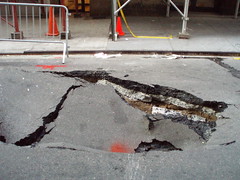
New York City streets look like an Oreo, a delectable sandwich of cooky-coloured asphalt, white stone, more asphalt, and a mysterious and appetizing chocolate (or coffee?) creme filling.
September 03, 2007
In which we go island-hopping


Governors, Coney, and Manhattan Islands with Aram and Mary.
We saw the Sideshow by the Seashore (although Insectavora was off that day), replete with fire-eaters, human blockheads, tight-rope walkers, snake charmers, and the mysterious mummified baby — was it really human?); we wandered through the toroids of Richard Serra at MoMA; we drank beers; we drank wine in the park.

Anna and I shared a Swingers cabin on the Wonder Wheel, and got an extra trip 'round because we didn't jump off after the second rotation; we were perhaps too busy looking at the piebald cat sitting on the fence surrounding the massive works of the Wheel itself. Just beyond the fence, a massive clearing where the go-kart track was just recently reminded us that the last days of Coney Island are nigh: at least, the last days of Coney Island as dissolute all-New York playground. Some rides are going, going, gone; condos are coming. Anna and I enjoyed a last swing on the Pirate, although Mary's camera had succumbed to the enthusiasm of the day and was out of battery, so the screams and expressions of glee are as fleeting as Astroland itself.
September 02, 2007
Freakonomics / Blink
I read Freakonomics and (most of) Blink; I had not read Malcolm Gladwell's previous book, The Tipping Point.
Both books address the insight of experts; Blink demonstrates how domain knowledge enables an expert to make a very rapid judgement, and Levitt and Dubner indicate how experts enjoy privileged information, which equates to an economic advantage. Gladwell's experts are sociologists who can tell, in seconds!, whether a marriage will last to five, fifteen, or infinite years; Freakonomics has experts who can sell a house or organize a xenophobic rally.
September 01, 2007
On the medley
... one of my favourite medley songs, from a concert set (thanks to Metafilter. I couldn't find another, "(Marie's the Name) His Latest Flame / Rusholme Ruffians" by The Smiths &mdash as captured on their fantastic live album, Rank.