April 29, 2009
I love my bicycle.
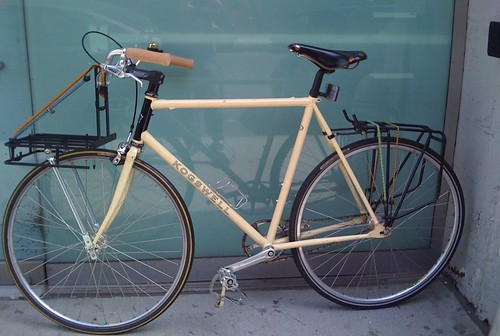
I built up this bicycle in autumn of 2002, and it went through a period of light use until the theft of the belovèd Gold Dutchess in the spring of 2005. Since moving last year, it has been the only bicycle I ride.
More photos of this Kogswell in various configurations; the memory of riding the Kogswell on the last Krispy Kreme Klassic.
April 25, 2009
In which we set an idol to the tune
Tarkovsky's Mirror Set to Arvo Pärt's Mirror in the Mirror :
April 21, 2009
On fried chicken and waffles
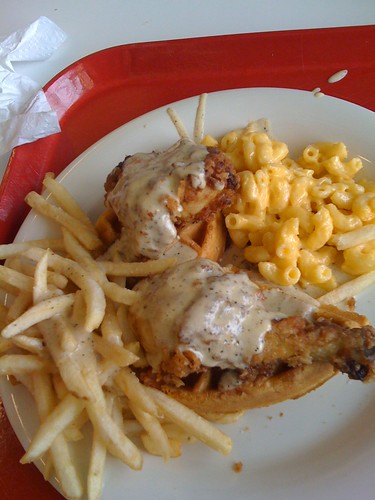
vs.

The first, from the cafeteria at work; the latter, from the chic restaurant down the fashionable street. Neither matches Roscoe's House of Chicken and W., a luminary institution just down the freeway.
April 20, 2009
April 19, 2009
10th and Stuyvesant Streets and 2nd Avenue
St.-Marks-In-The-Bowery, at the intersection of 10th and Stuyvesant Streets and 2nd Avenue, often has something happening in front of it.
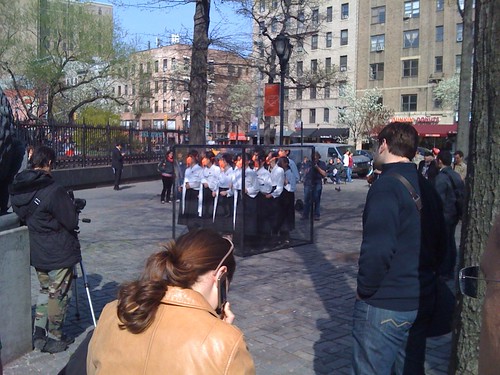
A group of young women, all wearing similar white blouses, medium-length black skirts, and bright safety orange face masks, stood in the square outside the church, calmly marching in place. As we watched, a similarly-attired woman opened the box and walked in; the man in front of me helpfully said that this was her work. Her dance? Her performance? Her political statement? He did not know, but expressed admiration and fascination.
April 18, 2009
In which we do not make an ass of ourselves
“I would ask people to actually go see a donkey basketball game before they jump on the bandwagon of trying to put it down."

The truth, my friends, is stranger than any fiction. Dwarf-tossing, quadriplegic rugby, midget-lifting, cock-fights — donkey basketball?
April 17, 2009
On spectacles and what they see
The Maysles Institute in Harlem moved a few months ago; I have not yet visited it.
April 8, 2009
In which we go out on a high note
"Folks, brace yourselves; hold on to something. Here's Sonic Youth. Yeah!"
vs
and, although I cannot embed the video for Do You Believe in Rapture?, it gets me all worked up every time I watch it.
The McCarren Pool show (from '06, not '08) had a nice version:This next song is called, I'm sorry, I forgot to tune my guitar before we went on-stage:
April 2, 2009
In which the heart muscle mass continues to grow
In a finding that may open new approaches to treating heart disease, Swedish scientists have succeeded in measuring a highly controversial property of the human heart — the rate at which its muscle cells are renewed during a person’s lifetime.
The finding upturns what has long been conventional wisdom: that the heart cannot produce new muscle cells and so people die with the same heart they were born with.
About 1 percent of the heart muscle cells are replaced every year at age 25, falling to less than a half of a percent per year at age 75, concludes a team of researchers led by Dr. Jonas Frisen of the Karolinska Institute in Stockholm.