December 03, 2005
In which I found that essence rare


Their second single, At Home He's A Tourist, actually made the UK Top 40, and Gang Of Four had been due to appear on Top Of The Pops, but were dropped at the last minute when they refused to remove the word 'rubbers' from the lyrics. Having retained their artistic integrity but missed their chance of wider fame, they were destined to remain a cult band, and they never again reached the singles chart.Aside: having a "six-degrees-of-Gang-of-Four" would be a fun past-time. If I recall aright, one of the Shriekback anthology CDs included a family tree, of sorts. How many bands does it take to span Mekons and XTC?
December 02, 2005
In which Lance strong-arms the bicycle messengers
Skidstrong bicycles, made in Ohio, have been bitch-slapped by Lance Armstrong's legal posse and have briefly changed their brand to "Skidmark", an even more unfortunate name than before. They have settled on FISSO, from the Italian for 'fixie'. The bicycles, frames and gear alike, are sold to raise money for the Bicycle Messenger Emergency Fund. They have some very nice-looking wool jerseys.

In more promising bicycle-related news, swobo report that they are looking for a new supplier for their warm wooly woven gloves: their previous supplier was decimated by Hurricane Katrina.
In which transit never comes quickly
The Examiner points out that the State of California is at least thirty years behind Japan, France, et al., when the matter of intercity transit comes up. And they should also point out that the City of San Francisco is at least fifteen minutes behind whatever municipal railway schedule is in place.
Study high-speed rail, keep S.F. central
Getting from place to place in California has always faced one enormous difficulty: the sheer size of the state, with major urban areas north and south hundreds of miles apart. Add to this problem the modern challenge of a highway system that doesn’t come close to keeping pace with the booming population, plus the cost and capacity restrictions of air travel, and the options for swift, simple travel between Los Angeles and San Francisco are few.
In fact, the most viable solution seems to be rail travel, which in other countries is a mode of fast transport that is popular and efficient. In France, the TGV train system started development in the 1960s and began operation in 1981. In Japan, the Shinkansen, or bullet train,” came on line in 1964. As much as Californians love their cars, the state — like much of the rest of the United States — has fallen behind this modern mode of transportation for decades.
Advocates of a high-speed train system linking the Bay Area with Southern California are studying how to make such a system work, an important project that deserves the attention of decision-makers at the state and local level.
That doesn’t mean that we need to tie the state to any particular plan right now, though. Should trains run on traditional steel rails, or use magnetic levitation or some other technology? Should a high-speed rail system be funded through public bonds or should the state seek a partnership with private entities? What route should a train take between the Bay Area and Los Angeles, and where should it stop along the way? The experts, government officials and the public will continue to hash out the details for a long time.
One thing should be clear going forward, though. The high-speed rail system must serve San Francisco as a terminus or major stop, rather than bypassing The City for a location in the East Bay or relegating it to an inefficient spur of the system. This is not about bulk cargo transport, where geography favors ship-train-truck connections in Oakland. High-speed rail is primarily about moving people, and when it comes to our local economy of ideas, San Francisco is where people need to go.
There have been rumblings from East Bay politicians that they would like to bring the trains there instead of San Francisco. These rumblings should be taken seriously — as a threat to both the practicality of the high-speed rail system and the political consensus that would be needed to get it rolling. It may be possible to develop a configuration that serves both San Francisco and the cities on the Bay’s eastern shore. But regardless of the final form any high-speed rail might take, residents and The City’s elected representatives in the state Legislature and in Congress should be unequivocal in their position that San Francisco must be a major component.
Routemasters

Back on the domestic front, a new less-than-admiring site about MUNI promises the lewd low-down on a lifestyle reliant on MUNI (is'n't that tautological? style and MUNI?). Can municide's author, Doug, pull off anything to compare with munihaiku dot com? With anonymously-contributed gems like "Waited forever. / And then you showed up for me. / Seven in a row.", it's hard to top for the title of "Best Onling Writing About Public Transit". For non-Lower Haight residents, those 17 syllables can only describe the ineffable 22-Fillmore.
SFist notes that it's more fun to walk in the rain than stand around waiting for MUNI in the rain. Word to that. To MUNI's credit, the agency is working with the community around Geary Boulevard to determine whether bus rapid transit will work. Forgive me for stating the obvious, but yes!, it will work: the 38 Geary is one of the most heavily-used lines in San Francisco (and thus, the Bay Area), and used by commuters, tourists, and vagabonds alike. It cuts across the entire northern part of San Francisco, and provides access to key densely-built and populous neighbourhoods (Pacific Heights, Japantown); business areas (Downtown, Civic Center, Tenderloin); and the beach. It runs on a wide roadway. This route is an ace in the hole for rapid transit. Politicos, planners, and plebians alike will all win big if this is built. Rapid Transit along Geary Boulevard will make people happy; in fact, it has the potential to change the way the city moves, for the better. But it will never be, because this is California, USA, and the agency in charge is MUNI, San Francisco MUNI, which cannot maintain its headways, cannot fit into its budget, and reduces service while increasing fares.
Buses all over the country honoured Rosa Parks, who died recently, with black ribbons and posters, as well as by designating the front seat of the bus as a quiet, symbolically empty, space. MUNI put up very nice posters on buses a few weeks ago, but they were all stolen within minutes of installation.
December 01, 2005

skunkworks
The phrase 'skunkworks' usually applies to the shadowy labs area of a company, the incubator within from which energetic new projects emerge. Sometimes these projects are underfunded, or not funded at all; they have no official role within the corporation's Grand Strategic Plan.
Or, perhaps, they are just mixing up the medicine: according to techtarget, the name comes from a bootlegger's setup in Al Capp's justly legendary newspaper comical strip, Li'l Abner, which I have been recently enjoying anew.
"skunkworks" was popularised at Lockheed Martin:
A skunkworks is a group of people who, in order to achieve unusual results, work on a project in a way that is outside the usual rules. A skunkworks is often a small team that assumes or is given responsibility for developing something in a short time with minimal management constraints. Typically, a skunkworks has a small number of members in order to reduce communications overhead. A skunkworks is sometimes used to spearhead a product design that thereafter will be developed according to the usual process. A skunkworks project may be secret.
In which no-one pulls the wool over my eyes
Six months after promising a long-awaited return, wooly cycling-gear iconoclasts Swobo are back in full effect. Their comfortable if anchronistic cycling clothing is unassuming, but best of all, it is awesomely well-constructed and lovingly made. Well, this was certainly true of the gear they made through '01, when Tim sold the company and the brand became dormant. Other cycling-gear manufacturers have tried to fill the gap, including one erstwhile fellow peddling knickerbocker leggings at $140 per at the recent San Francisco Bicycle Expo; longtime specialists Kucharik; and sundry others like REI and deFeet.
I try to adhere to the adage, and am wary of ventures which require new clothes, but I adore to pieces (literally: I have worn their cosy wool cycling gloves to rags) the various lush pieces of Swobo gear I have. And now I can replace my long-lost Kucharik beanie with a swank piece of new Swobo.
Swobo swobo swobo swobo.
Swobo swobo swobo swobo.
Swobo swobo? Swobo swobo.
Swobo swobo swobo swobo.
It's fun to say, and it's fun to type.
Swobo swobo swobo swobo.
Swobo swobo! Swobo swobo.
November 30, 2005
In which we have a story problem
A pretty girl leaves Union Square at 1730. At the same time, a man with a hat begins walking west-south-west on a one-point-three-mile route home'ards, a route that exactly matches several MUNI routes. At the height of rush hour, who will reach their destination first?
Answer: Our man is faster than a speeding MUNI bus. And he had time to stop at the shop and pick up some fiery orange-red lilies.
I am still a little perplexed as to how surface transit moves at an effective 3 mph during rush-hour. No, wait, it's coming to me: bus routes run on secondary roads, and so are subject to stops at each intersection. Some times the buses need to stop for traffic control on one side of the intersection, and then a bus stop on the other side of the intersection -- two stops in three bus-lengths.
In which Aram conquers all; Or, Burly, Part Two

Aram, true to his word, ascended haleakala on a fixed gear bike. I do'n't know why he has the FBI Witness Protection black bar in the photograph, but I'm pretty certain that is he triumphant (and above the cloud-line!). The already-impressive ride hit me with a double-whammy when I realised that, after he got all the way up, he had to get back down. Now that is burly. Hey! Burleigh would be a nice name for a glam-rock band. Wonder if we could practice in Greg's basement?
Some Buried Caesar
I was walking past Powell's Books on 57th Street some years ago when I saw the irresistible discards box outside. On the top was a torn paperback with a gaudy illustration: Some Buried Caesar was the title. Efffusive endorsements rang out from the front and back covers: "The best ... unbeatable!". The author: Rex Stout (what a great name!), creator of the irritating, contrary, and iconoclastic detective-gourmand Nero Wolfe. I recognised the name from a review (of what?) that I had read, which compared the author to P G Wodehouse and Rex Stout. Already having read, re-read, and much loved the former, I picked up the latter.
I could not have done better: Some Buried Caesar is one of Stout's earlier, "post-Depression and pre-war" mysteries, and shows his strengths beautifully. It features a different setting for the action: usually, Wolfe sits in his custom-made chair in his Manhattan townhouse, keeps to his schedule, berates Archie Goodwin, his Man Friday, and drinks beer. In this, the book starts off with Archie crashing the car en route to show orchids at the State Fair. From there, it is but a hop, skip, and jump to the introduction of Lily Rowan, who graces many subsequent mysteries in small but complicating roles; the revelation that Methodists make the best chicken fricassee (and do'n't hold the dumplings); and that anthrax is a disease of cattle. Really, I had not grasped this latter bit, despite the Gang of Four song, until this book's description of the disease as it ravages a cattle herd. Like Wodehouse, Stout has an easy way with words, and gives his characters such distinctive voices that they become caricatures of themselves. Archie would be the perfect tough guy for a Marlowe or Hammett novel, except that he is in the company of Wolfe, who is too cerebral for straight-up noir; Wolfe, confusingly, is also too decadent, in his quiet little "seventh-of-a-ton" way. He has a rooftop greehouse filled with roses, a private chef, and brooks no nonsense.
Some Buried Caesar is amongst my favourite mysteries; other Wolfe adventures I really enjoy are Fer-de-Lance, the first to feature the detective; Too Many Cooks; The League of Frightened Men, of which I found a first edition in a dusty shop in Palo Alto that burnt down a few days after I raided their selection; and Please Pass The Guilt, one of the later stories but featuring such odd period vocabulary as "balloon-rimmed cheaters". Even Google has not been able to help with illustrating that term.
November 29, 2005
In which I wants nae skinking ware
No haggis-based cocktail yet exists (horrors!), but apparently haggis season (as legitimate a holiday as any, I suppose. Any reason to have a pint!) is nigh. Th' other sort of haggis I have actually celebrated once or twice. I also celebrate the wikipedia.
While some people cheerfully get away with hunting down platypus-like Highlands creatures, and others skedaddle with boiled sheep's heart, lungs, and liver stuffed into a scoured-out stommick, others are pulling stunts closer to home: If I did this [Lengthy quicktime download], I'd get in trouble. How did the filmmakers clean up afterwards?
In which I wear out the shoe leather
As I found myself at Civic Center at 5.30 this evening, I looked at the surprisingly cloud-free sky and figured that I would walk home, rather than stand in a humid MUNI aisle. And then as I looked down Market and saw nary an outbound bus, I wondered if I might reach home faster than if I were to ride MUNI.
If I walk the MUNI route, I could easily see when one of the outbound buses might pass me. The route is pretty straightforward: along Market Street, turn right on Haight, and then bob's yr uncle.
I walked all the way to Larkin before two buses, both northbound 19-Polk trolleys, rolled sedately past. An F-Market screeched by as I waited at the infuriating intersection of Market and Van Ness. -- infuriating because of the new crosswalk signals, which beep incessantly. When one pushes them, the beeping changes (and a light comes on); what do the different beeps indicate? How might I, as a blind or deaf pedestrian, know what pushing the button accomplishes? And the only gain is a psychological one, for the light timing has not changed at all -- so pushing the button does not accelerate the pedestrian signal. What the intersection needs is an all-walk cycle, really, but that is tricky considering that Van Ness is really State Highway 101 in disguise.
I walked past several moaning derelicts and the new wine bar Cav before reaching the congested intersection of Franklin, Page, and Market: still no 6/66/7/71/71L in sight. Traffic on this stretch of Market gets all buggered up during rush-hour because of the way the freeway exit ramp defers north-bound crosstown traffic onto Market for two blocks before it reaches Franklin. Why Octavia Boulevard does not reach Geary I will never understand -- I swear that is what I thought I voted for all those years back!
I started walking up the last stretch towards home, and not without a trace of worry on my brow: well into the rush hour, and not a single bus had passed me. I saw what looked like MUNI tail-lights ahead, on th' other side of Octavia, but nothing behind me. Might I actually overtake MUNI? I chuckled at the thought.
I waited on the east side of Octavia. A cyclist was getting a little ahead of himself, skillz-wise, with a limp attempt at a track-stand, and kept lurching into the intersection. (Aside: How do you manage to not 'track' stand when pointing uphill?) Finally a big pickup truck honked at him, and he turned back towards me and said, "Will you look at that. They're mad because they're stuck in traffic, and they take it out on us." I told him, "If I had a horn, I would honk it at you. You are in the intersection against the light, and that's not only disrespectful, but your guardian angel is working overtime." Before I finished, he spluttered, "I can't believe you're on the side of the cars!", issued a few choice epithets, and turned to ride off, only to then realise that he was in the headlights of another oncoming car. I smiled. As the light changed and he finally took off, I saw that he was stupidly riding with a freewheel.
I figured that a bus would catch me up for certain as I had to keep in low gear walking up the three blocks towards the Lower Haight, but it was not until I passed the bus stop closest to home before MUNI, and I would'n't have taken the bus -- it was a 71L and did'n't even stop. A 66 Parnassus and I reached the corner of my block at the same time. Twenty-five minutes, during which not a single bus passed me.
I beat MUNI home during rush-hour.
November 28, 2005
In which we are caught between a rock and a just-say-no place

I ca'n't stop laughing at the idea of paying a tax on marijuana. From the Tennessee State Revenue documentation on the topic:
- If I purchase stamps, will I then be in legal possession of the drugs?
- No, purchasing stamps only fulfills your civil tax obligation. You will still be subject to the criminal statutes of Tennessee for possessing the drugs.
This is how the IRS nabbed Capone, is'n't it?
In which I repurpose content
In late '82, I was already a denizen of the remainder table at the local booksellers, and picked up a copy of Best Editorial Cartoons of the Year (1981 Edition). Fantastic stuff lay within: not only had Reagan trounced Carter in the recent national election, but all sorts of exciting governmental shenanigans, both on the federal stage (Stockman was getting worked over in Congress about his fantastic supply-side economics proposals) and local (Californians feared the medfly) provided cartoonists with fodder. I began to read editorial cartoons avidly, and looked forward to the brief chrestomathy presented each Sunday in the New York Times' Week in Review. rss feeds of various editorial cartoonists, such as Tom Tomorrow's This Modern World, satisfy but a small stretch of itch. Happily, isnoop comes to the rescue. The comic-strip snagger even allows a zoom level, so mine tired eyes can see the venerable drawings of Charles Schulz and Al Capp double-size!
November 27, 2005
In which I revel in being contrary; Or, Turk and Hyde
I appreciate the bustle of the (big) city as much as the next condo-dweller, but I especially like the quiet moments when the city sleeps. I revel in seeing which other lights are on, who is walking down the streets (insomniac joggers and groggy dog-owners, mostly, of a Sunday morning). In the interrgenum between the time that bars shut down and greasy-spoons open, the newspapers noisily arrive, thumping on stoops whacking against iron gates. Between last call and day-break, city crews patrol the streets, picking up trash from the night before. Between four and five this morning, a pile of old clothes and a cracked coffee maker appeared and disappeared from the corner. I even caught sight of a MUNI Owl bus service, ponderously making its way west'ards.
What shops are open in the early hours? Nothing, in this neighbourhood: the grates drawn across the windows belie the bright neon signs and wheezing air conditioners of the bodega across the street. A few blocks and a few hours away, the café-owner, clad in a beret and crisp blue shirt, shakes his head and says, "I never thought that anyone will be here first thing on a week-end, but you always are!". The croissants are still warm from the bakery, and the espresso machine is yet warming up.
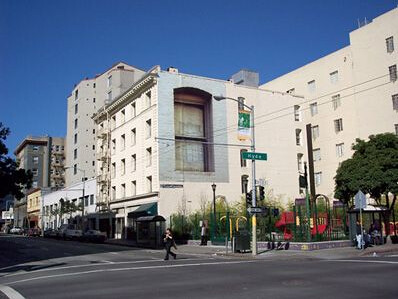
I have never seen the corner of Turk and Hyde as cheery as in this photograph of Felipe Dulzaides's "incidental vista", part of the Double Take installation art project.