June 04, 2005
The Great Train Story
Overheard at the Great Train Story:
"That combine is set up for corn, but you've got hay and wheat planted in that field."
I bet that the next time I visit the exhibit, the combine will be changed.
June 03, 2005
"I am so totally entertained"
by the potato gun.
As it turns out, this item, more a cannon than a gun, has a certain cachet. Several acquaintances claimed to have made one, and appropriately described the effect of a potato shot a few yards into a concrete wall as "liquefaction".
This has very little to do with this potato clock.
June 02, 2005
An admonition to eat, rather than throw, the veg
A Caltrain anecdote from some months ago -- probably mid-winter, when daylight was sparse --
Caltrain 246
depart SF 8.37at Hayward Park, a disheveled young man arrived on the platform at the same time as the train. He hurried to buy a ticket, stabbing at the buttons, but heard the train doors closed and turned to the conductor with a plea. The conductor shook his head and the train pulled away. The young man spat at the departing train; he wheeled and threw his lunch bag against the ground with such force that vegetables went flying everywhere.
June 01, 2005
Monkey got your back?
jimg pointed out this awesome photo:


In which my head is full of skriking kids
The word whinge evokes solid middle-Britain travails, and, that leads squarely to The Fall. Not only are they the quintessential loser (not in the Oasis sense, in the echt British sense) band, but they sing about whingeing (q.v., "Joker Hysterical Face", "It's a Curse!", and undoubtedly scads more), and the irascible singer, a certain Mark E. Smith of whom I am speaking, has a nasal voice that lends itself very well to complaining.
May 31, 2005
Doughnuts for dog-faces
June 3rd is Donut Day. Not merely some advertising exec's dream to drum up business, this tradition has its roots in The Salvation Army.

Donut Day was established in 1938 as a means to raise much-needed operating funds for The Salvation Army, and also as a tribute to Army 'lassies' who made and served donuts to thousands of soldiers during World War I. While the spelling of doughnut has shortened to "donut" over the years, the popular donut has been the trademark of The Salvation Army ever since WWI. While Donut Day was observed fairly extensively, especially following WWII, by The Salvation Army throughout the United States, the Army in Chicago has the longest continous and most successful tradition.
ED's ed
Leah Shahum, Executive Director of the San Francisco Bicycle Coalition, has an outstanding editorial in today's San Francisco Chronicle in which she notes that, although the city of San Francisco will host World Environment Day 2005 this week, we are far from exemplary in putting people first in our transit and urban planning.
May 30, 2005
Ashes to ashes
The left-overs from today's double order of wings went into the silky compost bag endorsed by the Biodegradeable Products Institute for use in the San Francisco residential composting program. The bags degrade quickly, and contain no plastic, but rather bio-polymers made from sustainably-farmed agriculture.
A day to remember
This was the Rastafarian dog I saw out at Crissy Field:
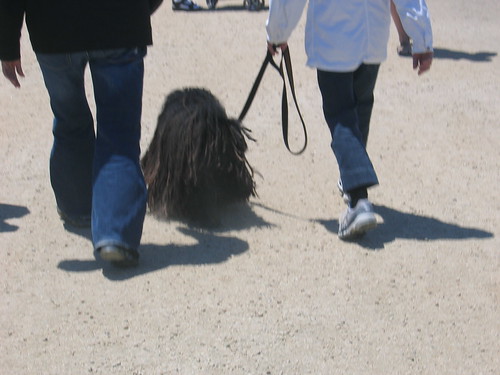
He looked the same, coming, going, sideways, top-wise, like a brush from a gas-station car-wash.
May 29, 2005
How to clean up after your dog
Although I'm often joking that Duboce Park reeks unto the Paris of the 17th century, the park now faces a crisis of Noe-Valley-esque proportions: apportioning spaces of the small, smelly park for dogs and for children.
The sanitary condition of the park depends on dog-caretakers cleaning up after their dogs, but would you sit down where a dog has just left a odiferous coil of poop or a steaming sizzle of urine? Dogs de facto own territory by marking it with their spoor. The attendant discolouration of grass definitely indicates the area where a child should not play.
If the proposal entailed something along the lines of New York City's dog run in Washington Square Park, perhaps the world could get along. But Duboce Park is too small for separate off-leash dog runs and child play areas.