June 12, 2004
A short-term effect?
Reading the Vintage Book of Amnesia, edited by Jonathan Lethem (whose Motherless Brooklyn I loved; unhappily, I haven't enjoyed any of this other books, excepting the fantastical, short, and tortuous The Shape We're In).
Aside from the beautiful "Nightmare" by Shirley Jackson and the whopping six-page story by Donald Bartheleme, many of the stories disappoint me, including Lethem's own contribution. An essay by neurologist Oliver Sacks discusses the physioloigical underpinnings of amnesia while describing the sad case of "The Last Hippie."
June 11, 2004
The ships are getting restless
Perusing The Outlaw Sea and thinking of  .
.
June 10, 2004
Clock-watching
BROOKLYN, N.Y. (Wireless Flash) -- The official organization that organizes food eating contests will unveil a wall of big eaters later today (Jun. 10) on Coney Island in New York.
The 50-foot by 70-foot Hot Dog Eating Wall of Fame will showcase heavy hitters Mike "the Scholar" DeVito, Ed "the Animal" Krachie, Takeru Kobayashi, Krazy Kevin Lipsitz and Hungry Charles Hardy, who are all winners of the International Hot Dog Eating Contest which takes place every July 4.
The wall will also include a clock which will count down the days, hours and minutes until the next hot dog eating contest.
International Federation of Competitive Eaters President Rich Shea says, "The Football Hall of Fame is in Canton, Ohio, and the Basketball Hall of Fame is in Springfield, Mass. I have never heard of a Super Bowl being played in Canton or a Championship Series being played in Springfield."
But the new wall will sit on the location where the Hot Dog Eating Championship takes place. He calls the new wall, "The Mount Rushmore of competitive eating."
June 09, 2004
The psycho zeta buckdown.
The twin prime conjecture and the Riemann hypothesis have long remained two of the long-standing conundrums in number theory.
And now they are solvéd? And the latter for a pretty purse?

De Branges is perhaps best known for solving another trenchant problem in mathematics, the Bieberbach conjecture, about 20 years ago.
Something I hope to understand in a few days
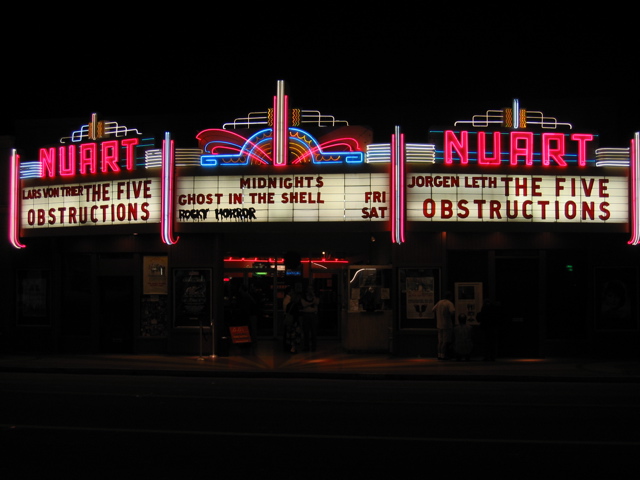
Took in a screening of Lars von Trier's latest, The Five Obstructions. This pits the idiosyncratic Danish director against Jørgen Leth, whom he cudgels into directing short films. Each film is a permutation of Leth's early short, The Perfect Human, with constraints imposed by Trier.
Permutation of music, film, and painting intrigues me: as Mark E. Smith records many versions of the same song, changing the pace, wording, instrumentation (Slang King#2), so did Michelangelo sculpt many slaves, so did El Greco paint many gentlemen of quality.
June 08, 2004
bus (+big)(+blue)
This morning I took the Big Blue Bus. Really. It is big and blue (and a bus). And (excuse me while I search for the ¢ key) only 75¢.
... and on the bus I thought about adding Geotags to this blog, and got lost in looking at USGS pictures of San Francisco.
Meanwhile, back at the ranch:

Caltrain spokeswoman Rita Haskin, described the Baby Bullet's premiere as perfect except that the commuter railroad had to turn away a couple of dozen bicyclists after the bike storage areas, which have half the capacity of normal trains, quickly filled."We had room for all the bicyclists but not for their bikes,'' she said. "But for commuters ... we think their expectations were met.''
June 07, 2004
A deep-fried love affair
I had a burger and fried pickles for lunch today. Typically a southern specialty, I've previously enjoyed them at State Fairs.
Elvis came across these in pickles at roadhouses outside Memphis; fried pickles are the perfect accompaniment to beer. They are believed to have been invented at the Hollywood, a roadhouse originally in Hollywood, Mississippi.
June 06, 2004
Arresting axe-murderers means bad news for woodcutters
Dr Gridlock fulminates against sidewalk-riding cyclists:
But according to [Advocacy for Respect for Cyclists] spokespeople, ticketing cyclists for breaking the law is only a "deterrent to cycling."
But it seems that many readers lump all cyclists into a category that is stereotypical: the flame-breathing bike courier who rides like a kamikaze pilot.
What about law-abiding cyclists who follow the rules, such as reader Ian More?
He writes: "I find that when I obey the traffic laws that I get quite a bit of abuse from fellow cyclists. There have been a couple of incidents where I stopped for a stop sign and was run into by another cyclist.
"My philosophy is to gain respect on the road by following the rules of the road."
By JEFF GRAY
Monday, June 7, 2004 - Page A13
Readers have a lot to say about cyclists.
And almost none of it is good.
"I've had my fill of the bleatings of these self-righteous, holier-than-thou cyclists, and particularly when it comes to bike lanes," Murray Wright writes in response to last week's column about cars parked in bike lanes.
"I walk two kilometres to work every day, and part of it is along College Street.
"I regularly encounter people riding on the sidewalk and there are bike lanes on both sides of the street, for crying out loud.
"There are inconsiderate pedestrians, motorists and cyclists, but according to the cyclists it's always somebody else who's in the wrong, never them."
Christine O'Connell writes: "Since the activists want bike lanes for themselves, why do we have to tolerate them riding on the sidewalks?
"They think they own the sidewalk.
"They wanted rights to ride on the streets with special lanes, so use them."
Certainly, cyclists riding on sidewalks are a pedestrian hazard in downtown Toronto.
Police say the practice is a major cause of accidents involving bikes.
Drivers watching for much slower pedestrians crossing the road are not expecting a bike to zip across a side street from a sidewalk.
And pedestrian-bike collisions can be bad as car accidents.
It is illegal to ride bikes with wheels more than 61 centimetres (24 inches) high on a sidewalk.
The fine for doing so is $90.
But as they do with some other traffic bylaws, police tend to enforce the bike rules only during blitzes in their efforts to get the message across.
Some cycling activists, such as those in the group Advocacy for Respect for Cyclists, reject that approach.
In its recent Bicycling in Toronto report card, issued at the end of the city's Bike Week, ARC called for an end to the annual Cycle Right campaign by police, which is to start today.
Police say they plan to ticket drivers and cyclists who break the rules during the two-week blitz.
But according to ARC spokespeople, ticketing cyclists for breaking the law is only a "deterrent to cycling."
Of acts police deem "aggressive riding," such as riding on the sidewalk, blowing through stoplights or zipping the wrong way up one-way streets, ARC says: "There is nothing inherent in these ways of riding that makes them aggressive.
"In many cases they are the best, safest choice a cyclist may have."
ARC and the police have a bit of history: The group says the police presence for its regular Critical Mass rides is excessive.
(Police say they are only enforcing the law.)
Only a tiny minority of cyclists are members of groups such as ARC.
But it seems that many readers lump all cyclists into a category that is stereotypical: the flame-breathing bike courier who rides like a kamikaze pilot.
What about law-abiding cyclists who follow the rules, such as reader Ian More?
He writes: "I find that when I obey the traffic laws that I get quite a bit of abuse from fellow cyclists. There have been a couple of incidents where I stopped for a stop sign and was run into by another cyclist.
"My philosophy is to gain respect on the road by following the rules of the road."
Dr. Gridlock, who plans to ride regularly again soon, agrees.