May 15, 2004
The demand for their real happiness
Published: May 15, 2004To the Editor:
The Mormon student at the University of Utah who was forced out of a theater program after refusing to read a script containing profanity is wrong to suggest that the university violated her constitutional right of free exercise of religion (Religion Journal, May 8). The student could have dropped the class if she was offended by it, or she could have gone to a private school organized around her religious beliefs.
Public universities have a constitutional duty not to tailor their curriculums to religious dogma. A student who takes a geology class and writes on the final exam that the earth is only 6,000 years old is probably going to fail the class, even if the student insists that being compelled to give any other answer would force her to renounce her religious beliefs.
DAVID R. DOW
Houston, May 8, 2004
The writer is a professor at the University of Houston Law Center.
May 14, 2004
La vomitera
Un altre conte fantàstic sense cap relació amb la realitat real... Aquesta setmana un virus m'ha destorbat la digestió, m'ha... (comentaris: 2) [Sarcophilus.blog]
m4d sk1llz but l33t to the game
I blame Aram for getting l33t speak into my craw. Then again, I also have him (or the most eligible bachelor in Chicago) to blame^W credit with the introduction of
This photograph is kind of hippie bling, I suppose:


May 13, 2004
A subway named möbius
Many years ago, I read a collection of science-fiction short stories that included A J Deutsch's "A Subway Named Möbius:" in this story, a new addition to the Boston T resulted in a topological anomaly, and the train carriages went missing on the track.
An Argentinian crew moved the story to the labyrinthine subway of Buenos Aires; I can't find this on disc, though.

... this seems to be the most popular story associated with the author; it turns up all over the web, but very little else does!
For the what now?
yesterday I got the word nonce in my noggin.
Does nonce have a notion of ephemeral tucked into it? What of the gentle decay of the moment? The decay of machinery?
The oracle of MUNI
For the second day in a row, I found myself waiting inordinately long for the J-Church. An older man resignedly said that he'd been waiting quite some time: "The trains come every thirty minutes now. This used to be a good line."
Despite the uncanny predictions of NextBus, the J hasn't shown up according to schedule three of the last three occasions I've waited for it; today when we finally boarded (based on predictions obtained at 0800, three J cars should have passed by), the carriage was jammed. A lot of the passengers were students, wearing signs in memoriam Ray Ray.
May 12, 2004
The Dude abides.
Heading down to the ol' corporate shuttle (as the steelworkers had the inclines, so have we our company transport), I hopped on the J-Church. For the second time in as many weeks, the driver had taped newspaper over the window and pulled it to: the fare-box was broken. Unsurprisingly, because the guy who repairs them was indicted for pilfering last week.
On return trip, I jumped over to the ever-expanding BART and promptly ran into Celeste, who was riding a bicycle saved from my basement (she has recently added a spiffy new saddle). Then I walked up to the front car and saw Anna!
And the whole excursion took us over to Chez Shumariley, where we, along with Jender and He-Who-Is-Full-of-Wrath, took in The Big Lebowski. Although I still don't care for the movie, I did enjoy hearing The Monks as background music in one of the early bowling scenes. This led me to a side-trip through the M section of the ol' iPod: The Minutemen ("West Germany"), Mission of Burma ("This is Not a Photograph"), and, of course, Modest Mouse ("Talking Shit About a Pretty Sunset"). How full of vitriol the Ms are!
A matched control subject
The subject of a landmark case in scientific ethics as well as the physiological basis of
sexual identity died last week.
May 12, 2004
David Reimer, 38, Subject of the John/Joan Case, Dies
By THE ASSOCIATED PRESS
WINNIPEG, Manitoba, May 11 — David Reimer, a man who was born a boy but
raised as a girl in a famous medical experiment, only to reassert his
male identity in the last 20 years of his life, died on May 4. He was
38. His family says he committed suicide.
Mr. Reimer shared his story about his life in the pages of a book and
on Oprah Winfrey's television show.
His mother, Janet Reimer, said she believed that her son would still be
alive had it not been for the devastating experiment, which led to much
emotional hardship.
"He managed to have so much courage," she said Sunday. "I think he felt
he had no options. It just kept building up and building up."
After a botched circumcision operation when he was a toddler, David
Reimer became the subject of a study that became known as the John/Joan
case in the 60's and 70's. His mother said she was still angry with the
Baltimore doctor who persuaded her and her husband, Ron, to give female
hormones to their son and raise him as a daughter.
As he grew up as Brenda in Winnipeg, he faced cruelty from the other
children. "They wouldn't let him use the boys' washroom or the girls',"
Ms. Reimer recalled. "He had to go in the back alley."
His sexual reassignment was then widely reported as a success and proof
that children are not by nature feminine or masculine but through
nurture are socialized to become girls or boys. David's identical twin
brother, Brian, offered researchers a matched control subject.
But when, as a teenager, he discovered the truth about his past , he
resumed his male identity, eventually marrying and becoming a
stepfather to three children.
In 2000, John Colapinto wrote "As Nature Made Him: The Boy Who Was
Raised as a Girl," providing David an opportunity to tell his story. He
wanted to save other children from a similar fate, his mother said.
While he had spoken anonymously in the past, he entered the public eye
after the book was published, beginning with an appearance on "Oprah"
in February 2000.
His mother said he had recently become depressed after losing his job
and separating from his wife. He was also still grieving over the death
of his twin brother two years earlier, she said.
Copyright 2004 The New York Times Company
Togs
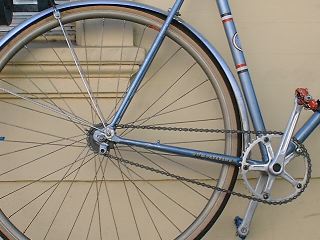
Do the clothes make the man? Today I'm wearing socks with a warthog on a fixie and a t-shirt with a buffalo


 +
+
May 11, 2004
An empty space, or a missing part?
lacunary appeared as a predicate adjective at work today, but I didn't realise that the term applies more commonly to mathematical problems than to linguistic.
May 10, 2004
Everything comes together this summer
The San Francisco Chronicle issued a warning about "licker" shock: the rising price of ice cream.
Blame it on bad timing. A combination of political unrest and natural disasters overseas, and fluctuations in the dairy industry in this country has left ice cream manufacturers grappling with higher prices for key ingredients including milk, vanilla and cocoa.
For instance, a pint of Ben-and-Jerry's is going to cost eight percent more. And a multipack of Klondike bars will cost about ten cents more.Massachusetts-based Friendly's ice cream chain cut its half-gallon tub from 64 ounces to 56 ounces earlier this year ... and it just increased its retail prices by five percent.
www.sfgate.com Return to regular view
DIET: Higher prices may cause ``licker shock'' at the ice cream stands this summer
J.M. HIRSCH, Associated Press Writer
Monday, May 10, 2004
©2004 Associated Press
URL: sfgate.com/cgi-bin/article.cgi?file=/news/archive/2004/05/10/financial1511EDT0163.DTL
(05-10) 12:11 PDT (AP) --
Already staggering from sticker shock at the gas pump, consumers may suffer "licker shock" at the ice cream stand this summer when they see some of the industry's biggest price hikes ever.
Blame it on bad timing. A combination of political unrest and natural disasters overseas, and fluctuations in the dairy industry in this country has left ice cream manufacturers grappling with higher prices for key ingredients including milk, vanilla and cocoa.
"I have been in this industry for nearly 20 years and I have never seen all of these things come together at one time," said Lynda Utterback, executive director of the National Ice Cream Retailers Association.
Although large manufacturers can absorb some of the higher production costs, consumers can still expect to pay more for everything from pints in the grocery store to cones at the stand and push-pops off the truck.
How much more? Estimates vary from 6 percent to as much as 20 percent or more, depending on region and product.
A pint of Ben & Jerry's is going up 8 percent, the most in the company's 26 years. Klondike bars will cost 10 cents more per multipack, according to manufacturer Good Humor-Breyers Ice Cream.
The rising prices also are accelerating a recent trend -- companies shrinking packages but keeping prices the same in what effectively is a net price increase. In January, Wilbraham, Mass.-based Friendly's rolled out its 56-ounce half-gallon tub -- down from the standard 64 ounces -- and this month increased its retail prices by 5 percent.
Consumers irritated by the increase aren't likely to find much relief, said Danielle Tirrell, manager of Arnie's Place ice cream stand in Concord, N.H., where the price of a regular cone is up 20 cents from last year to $2.35 and may go higher.
"Every once in a while I hear someone say, 'Wow, that's expensive,"' she said. "I've had one guy say 'Your prices are up over last year. I'm going to go someplace else.' Well, you can go someplace else, but their prices will be up, too."
Retail and restaurant ice cream make up a $20 billion business in the United States, where nearly 1.6 billion gallons are produced each year, according to Bob Yonkers, chief economist for the International Dairy Foods Association.
The average person eats 26 servings of ice cream a year, according to The NPD Group, a market research firm.
Until recently, the price of ice cream was moderated by a glut of milk. But low prices drove many farmers from the industry, and those who remain have fewer cattle following a mad cow-induced ban on importing them from Canada.
This year, demand is up and farmers can't keep pace. That's driving up the cost of the milk and butterfat needed to make ice cream, Yonkers said.
The industry also is squeezed by vanilla prices, Utterback said. A series of cyclones that hit Madagascar in recent years damaged much of the vanilla crop, driving the price per gallon for vanilla syrup from $75 to between $400 and $800.
And cocoa prices are up about $1 a pound because political unrest in the Ivory Coast -- where roughly 40 percent of the world's cocoa crop is grown -- drove many farmers from their lands, she said. The jump in prices is the highest in 17 years.
Many in the ice cream industry have some consolation in the fact that it's early in the season, and therefore easier to post higher prices than it would be during the summer.
"Once it's out on the street it's very, very hard to raise prices. A child comes out one day and it's $1. The next day it's $1.25. That just doesn't work," said Steve Feldman, owner of Houston-based Southern Ice Cream Corp.
Utterback is optimistic about sales. She said ice cream generally is protected by the comfort food factor -- when the economy is bad, ice cream sales go up.
Although the price increase is painful, some manufacturers say dairy farmers are long overdue for a break.
"Obviously we're concerned, but our main concern is for the small family farms and making sure they can make a livable wage," said Chrystie Heimert, spokeswoman for Ben & Jerry's.
But people like Nick Nikbakht, owner of San Jose, Calif.-based Golden State Ice Cream, wonder how long they can hold on. His company supplies ice cream to those iconic trucks that jingle their way through neighborhoods
He said he can't pass on the price increase to the trucks' owners, who also are feeling pinched by gas prices.
"The bottom line is they will not like it and they will just complain a lot and they won't be able to absorb all the increases," Nikbakht said. "We have to absorb it and hope the price will stabilize."
So what's an ice cream lover facing a long hot summer to do? Debbie Carpenter, a Concord, N.H., woman who recently treated her 4-year-old son to an ice cream at Arnie's, said the prices mean choosing where, not whether.
"It's ridiculous," she said. "You can go to the market and buy a half-gallon for the same price as a small (cone)."
©2004 Associated Press
Pile-up at Church and Duboce
Where is the Church on Church St.? And what happened to the N-Judah this morning? Just before 0800, a 2-car N stopped outside the Market Street Subway entrance and sat there for several minutes. The next warning came from the destination sign: it started rolling towards "J" and then "F" and finally came to rest nowhere in particular.
Two 2-car trains stacked up between the Duboce Park station and the intersection(*) of Sanchez/Steiner and Duboce; another two Ns were stopped between there and Church. Automotive traffic was not pleased: another reason for a transit-first policy on this stretch.
Old Men Who Get Fat In The Winter
A 50-year old mustachioed man, wearing shorts with the motto "Ride to Eat / Eat to Ride" ("It was a Father's Day gift from my wife," he said. "She thought it was a joke." I nodded knowingly), told me that the railroad right-of-way from Samuel P. Taylor out to Point Reyes Station will be made accessible as a bicycle path sometime this summer.
Perfect for a summer weekend ride: spend the night out at a B&B, and then bike back the next day.
May 09, 2004
The Lake Project
Some sculptors (photographers?) have an obsession with interpreting the implications of environmental degradation.

Like the Spiral Jetty, the physical evolution of the piece is important; as with Andy Goldsworthy, photography is integral.
May 9, 2004
Hell From the Air: California's Toxic Landscape
By AMEI WALLACH
`David Maisel: The Lake Project'
James Nicholson Gallery, 49 Geary Street,
San Francisco. Through May 29.
SAUSALITO, Calif.
RIDING in a steeply banking Cessna four-seater three years ago, David Maisel leaned out into a clamorous, icy wind and photographed the toxic, desiccated surface of Owens Lake. "You feel like you're descending into these layers of hell," he says of the plane's dive from 3,500 feet. "You're a disembodied eye and the lake bed has this corporeal aspect. It's like a body that has undergone surgery, with red veins that seem internal."
As Mr. Maisel renders it, the lake, which has been drained over the last 90 years to green the lawns and ice the whiskeys of Los Angeles, looks scourged and flayed. The red veins are concentrations of bacteria and minerals, making the Owens Valley in southeastern California the country's largest source of particulate-matter pollution when the winds blow. Local residents call the relentless clouds of cadmium, chromium, arsenic, chlorine and iron the "Keeler cloud" in honor of a small settlement at the edge of the lake best known from Roman Polanski's 1974 film "Chinatown."
In Mr. Maisel's photos, the vistas are majestic, terrifying and weirdly beautiful. They seem more intimate than microscopic data, vaster than extraterrestrial space. They are on view at the James Nicholson Gallery in San Francisco and have just been published in "David Maisel: The Lake Project," by Nazraeli Press.
Mr. Maisel, 43, belongs to a growing category of photographers — like Richard Misrach, Edward Burtynsky and Emmet Gowin — obsessed with interpreting the implications of environmental degradation, often seen from the air. (A more romanticized version of the form was popularized by the French photographer Yann Arthus-Bertrand's traveling international outdoor exhibition and book, "Earth From Above.")
Mr. Maisel was a student at Princeton when he helped Mr. Gowin photograph the aftermath of the Mount St. Helens eruption. He compares his own work to the apocalyptic, mythological landscapes of Anselm Kiefer. Like Mr. Kiefer's paintings, which draw the viewer into a contemplation of history, "The Lake Project" implicates both photographer and viewer in the horror and beauty of what they see. "I want the images to be troubling," Mr. Maisel said recently in his studio here. "You're seduced by the incredible images and their strange unworldly beauty, and then you find out what they're about and you're betrayed. It parallels the ways we are seduced as a contemporary society into believing that how we live doesn't matter."
After graduate school in architecture and landscape architecture at Harvard, he photographed Rocky Mountain copper mines "and the whole miasma of destruction associated with the process," as he put it. But when he processed the film, he found himself unwilling to play the blame game. "Who am I to criticize?" he asked. "I live in the 20th century. I have copper rivets on my jeans." So he dropped the give-away titles, like "Cyanide Leaching Fields," and began numbering his images, so that their hallucinogenic mystery would take precedence. The specifics of environmental decimation, along with images from his many photographic series, are available on his Web site, www.davidmaisel.com.
But the images never entirely resolved into abstract form. "It occurred to me that I could be taking pictures of my studio floor," he said, lifting a foot off the red-stained concrete that was scored with lines left by the glue that once secured linoleum tiles. "It does look like something I would shoot," he noted. "But to me it would be meaningless. There is a way that I'm trying to move back and forth between the content and the process of abstraction, where the image alone can take you in and you can respond to it as metaphor."
He first photographed Owens Lake on Sept. 5 and 6, 2001, concentrating on the creases of salt that ruptured the shallow pools of blood-red bacteria. After Sept. 11, he didn't want to look at those pictures so connected in his mind to the bloodshed in New York, where he grew up. When he returned to the project in 2002, the Environmental Protection Agency had begun flooding the lake to control the polluting clouds of minerals. He started to feel that he was viewing a process of artificial resuscitation, as if the lake were a body under a surgeon's knife. His mother had died in 1998 after a succession of heart operations, and he said he equated his photography to "an autopsy, with the idea that you can assemble the parts of a body and think you might actually reveal a whole person."
Geometry, however, remains the more prevalent theme in his work. It emerges in his latest project, "Terminal Mirage," which chronicles the Great Salt Lake and the re-emergence of Robert Smithson's earth sculpture, "Spiral Jetty." In one extraordinary photograph, the jetty is a diminutive line of coiling white, like a drawing that dissolves into stained washes of amethyst and Pompeiian red.
"I used to make imaginary drawings that were like these images — it's in my brain, and it has to come out one way or another," Mr. Maisel said, lifting photograph after photograph out of a box. "With this new body of work, I don't feel the burden of the history of Owens Lake or the death of my mother." He closed the box. "I'm much more free," he said. "I'm tempted to draw again."
The art critic Amei Wallach has written for Art in America, ArtNews and The Nation.
Copyright 2004 The New York Times Company